Hand phone / Whatsapp

+86-155-8805-8177
Products
Home / Plywood plant / Full Set Plywood Making Machine 4x8ft 60 Sheets/Hour Complete Plywood Plant
Contact Us For Price

loading

Share to:
facebook sharing button
twitter sharing button
line sharing button
wechat sharing button
linkedin sharing button
pinterest sharing button
whatsapp sharing button
sharethis sharing button

Full Set Plywood Making Machine 4x8ft 60 Sheets/Hour Complete Plywood Plant

Availability:
Quantity:
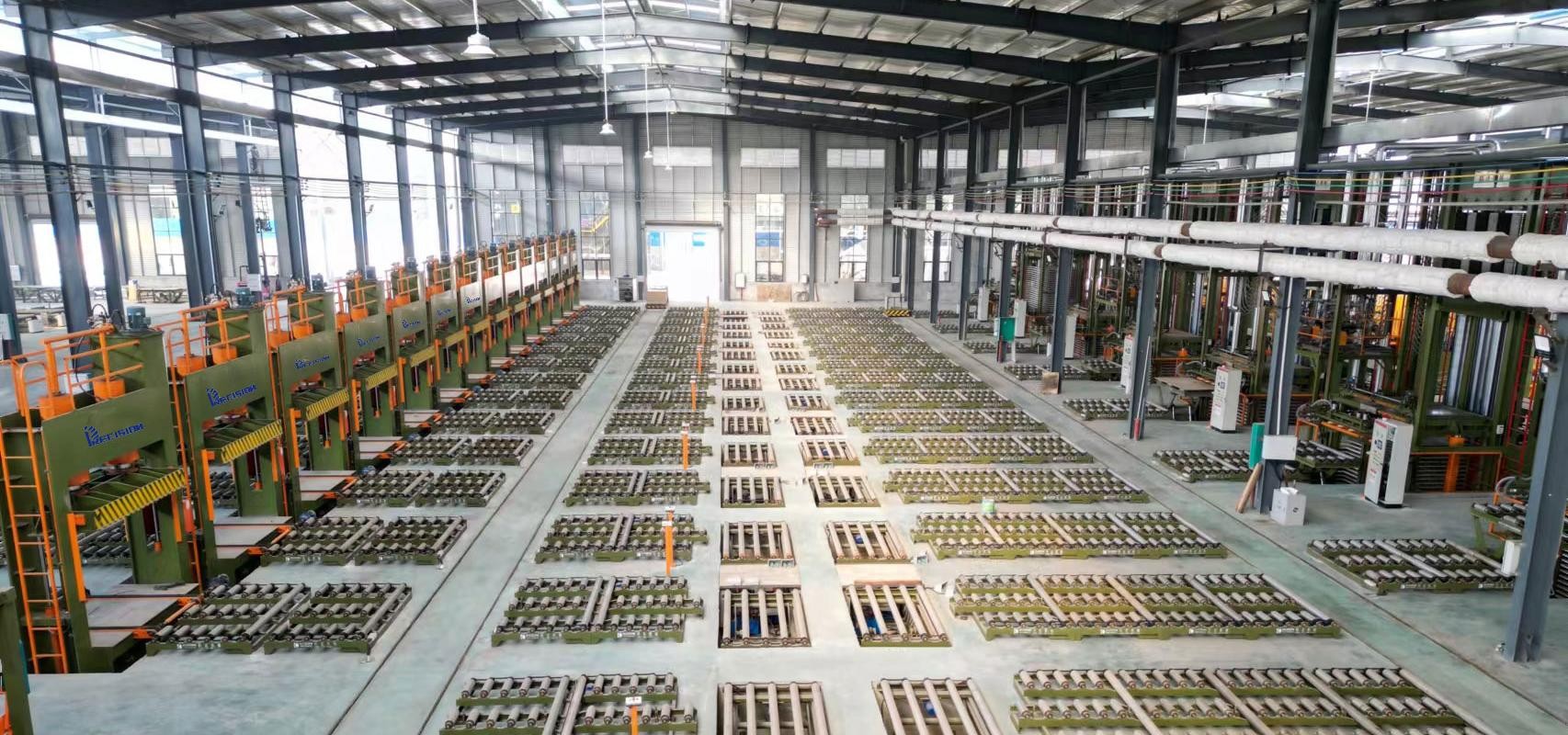
Plywood plant workshop
Complete plywood plant · logs in, panels out

Plywood Production Line — From Logs to Finished Panels

This plywood production line has 7 stages: peeling, drying, sorting, core assembling, gluing, pressing, trimming and sanding. Every machine below shows its real configuration, rated parameters and photo from the plant proposal.

60 finished panels / hour
12 main machines in 7 stages
4×8 ft standard panel size · 5–40 mm
8 optional support machines

PRODUCTION FLOW · 7 STAGES

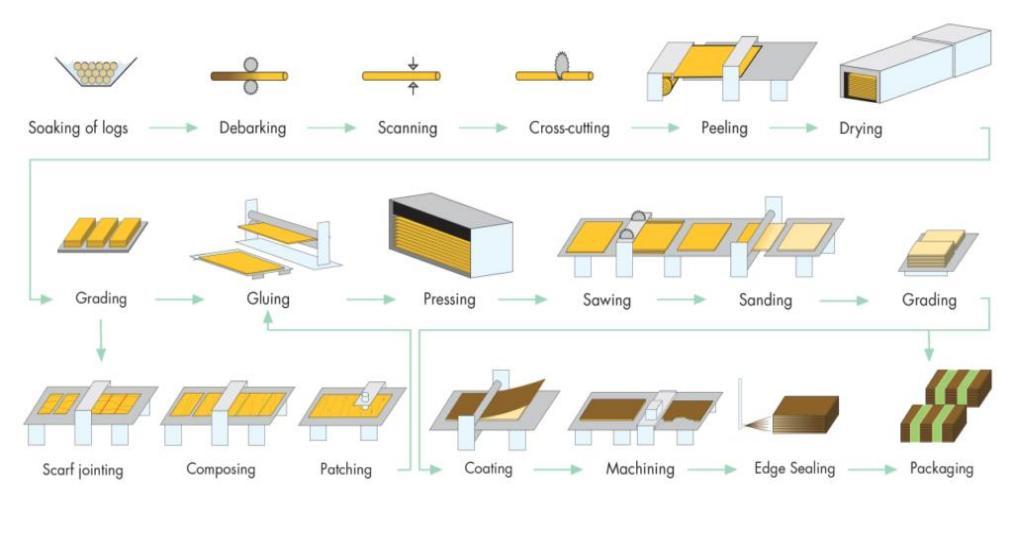
Plywood production process flow diagram
Soaking → Debarking → Peeling → Drying → Grading → Joining / Patching → Gluing & Lay-up → Cold / Hot Press → Trimming → Sanding → Packing

Why the order matters

A plywood produciton line follows this order. Plywood starts from a log the first step,we peel a log into veneer,size 4x8ft,4x4ft,or 4x2ft, then the veneer need be dried from moisture 50%-60% to a requirement moisture8_12% .the next step is glue veneer then assemble veneer by a princleble of one layer of short grain veneer,one layer long grain veneer the 4ft step is pressed .the plywood should be cold press first to shorten thepress time and save space ,then be sent to hot press hold 20-30 minutes.then edge saw cut off the roughedge ,last step is sanding to get a better flatness and uniformity . a perfect plywood finished. Reference 1

PART 01

Veneer Peeling

Face veneer + core veneer

Spindleless peeling

A spindleless veneer peeling machine holds the log between two friction rollers and a pressure roller. No spindle or chuck is needed. The rollers turn the log against the knife and peel a continuous ribbon. A servo sets the thickness. An inbuilt clipper cuts the ribbon to length. Short logs and small logs can be peeled down to a 32 mm core, so wood recovery is higher. Normal peeling speed is 30–110 m/min and veneer thickness is 1–4 mm. The machines below are in this range. Reference 2 · Reference 3

1

Face veneer · 9 ft spindleless veneer peeling line

≈ 2 m³/h
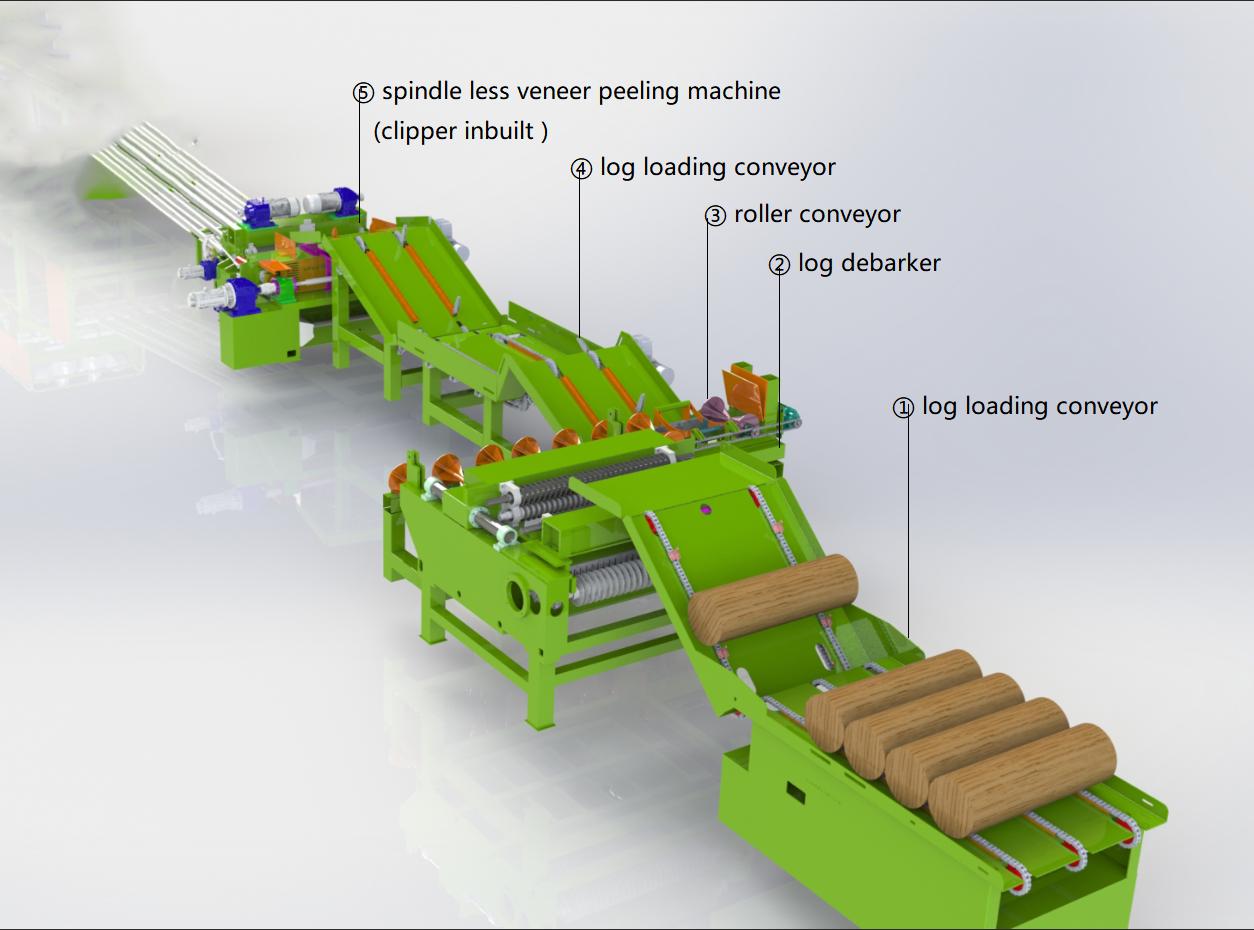
9 ft spindleless veneer peeling line
Complete peeling line · log conveyor → debarker → peeler with inbuilt clipper

1 · Log loading conveyor

Size 3 m + 2 m
Power 5 kW

2 · Log debarker

Log length 9 ft / 2600 mm
Single roller / double roller 11 kW × 2 / 11 kW × 2
Feeding power · total 7.5 kW · 51.5 kW

3–4 · Conveyors

Roller conveyor 4 m · 3 kW
Log loading conveyor 1.5 m + 3 m + 2 m · 6 kW

5 · Spindleless veneer peeling machine (clipper inbuilt)

Log length / diameter ≤ 2600 mm (9 ft) · ≤ 500 mm
Left log core 32 mm
Veneer thickness 1–4 mm
Double / single roller 15 kW × 2 / 11 kW × 2
Feeding · cutting · conveyor 15 kW servo · 2.2 kW · 2.2 kW
Peeling speed 30–80 m/min
Total power / weight 71.4 kW · 12 t
Process role: makes the 9 ft face and back veneer for the outside plies.
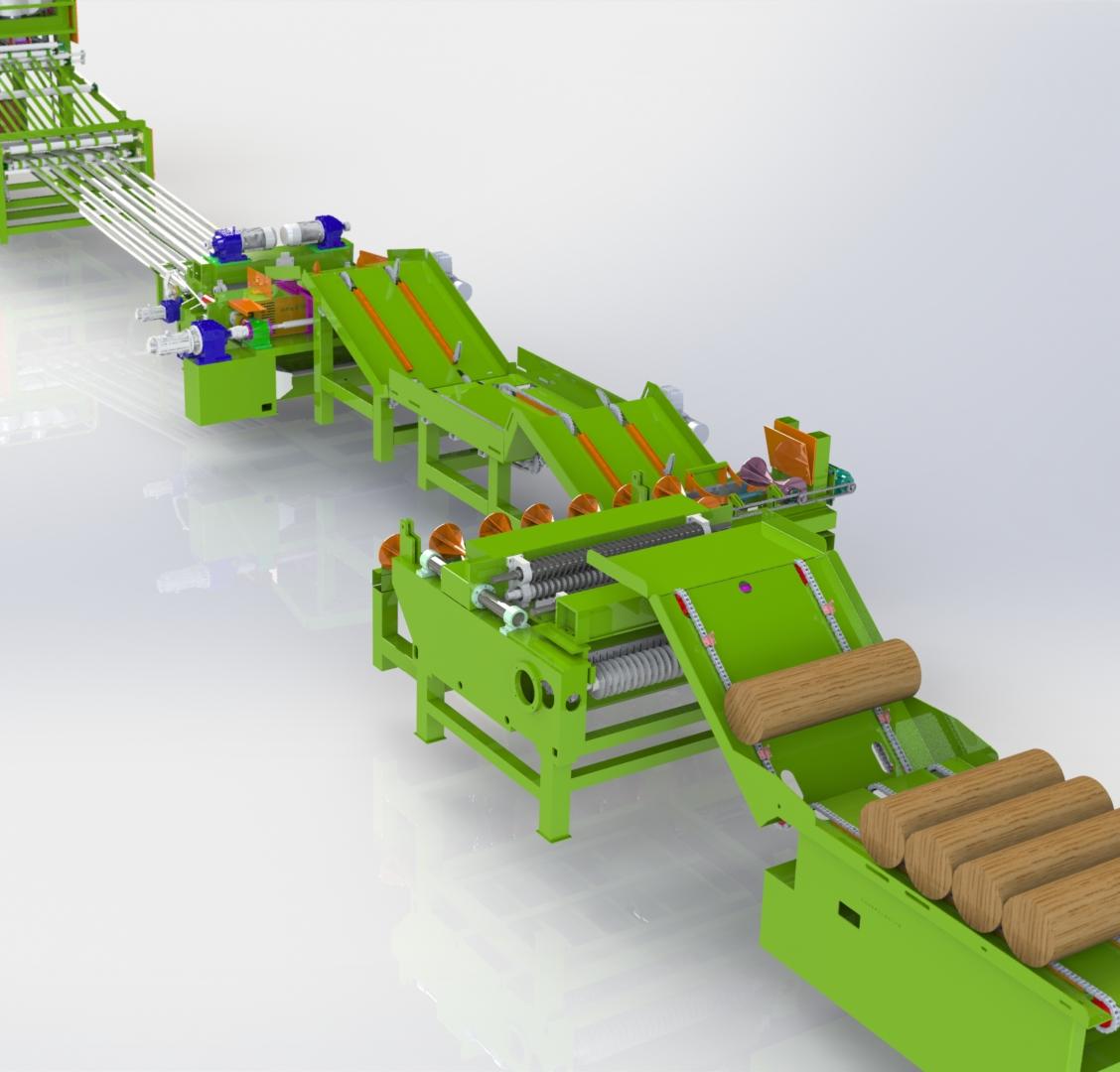
2

Core veneer · automatic 4 ft spindleless peeling line

≈ 3 m³/h
4 ft spindleless veneer peeling line
4 ft peeling line with veneer stacker · one debarker can serve two peelers

1–2 · Feeding and debarking

Log loading conveyor 3 m + 2 m · 5 kW
4 ft log debarker 1300 mm log; single 11 kW, double 11 kW, feeding 7.5 kW · total 29.5 kW

3–4 · Conveyors

Roller conveyor 5 m · 3 kW
Log loading conveyor 1.5 m + 3 m + 2 m · 6 kW

5 · Spindleless peeling machine (clipper inbuilt)

Log length / diameter ≤ 2600 mm (9 ft) · ≤ 500 mm as quoted
Left core / thickness 32 mm · 1–4 mm
Rollers / feeding 15 kW × 2 + 11 kW × 2 · 15 kW servo
Speed · total power · weight 30–80 m/min · 71.4 kW · 12 t

6 · Veneer stacker

Veneer size / power 4 × 2 ft (1300 × 640 mm) · 2.2 kW × 4
Process role: makes 4 ft core strips. Part 3 joins them into full-size core sheets.
PART 02

Veneer Drying & Grading

Moisture control and ply selection

The 8–12% moisture window

Fresh veneer leaves the peeler at 50–60% moisture. For plywood it must be dried to 8–12%; core stock often targets 12 ±1%. If it is too wet, water turns to steam in the press and causes blisters and delamination. If it is too dry, the veneer cracks. A veneer roller dryer keeps the sheets flat between rollers. Hot air from thermal oil or steam dries both faces. Normal drying temperature is 130–190 °C. Moisture deviation within a batch stays near ±2%. Reference 4 · Reference 5

3

Roller veneer drying machine · 4 deck

4.3–5 m³/h
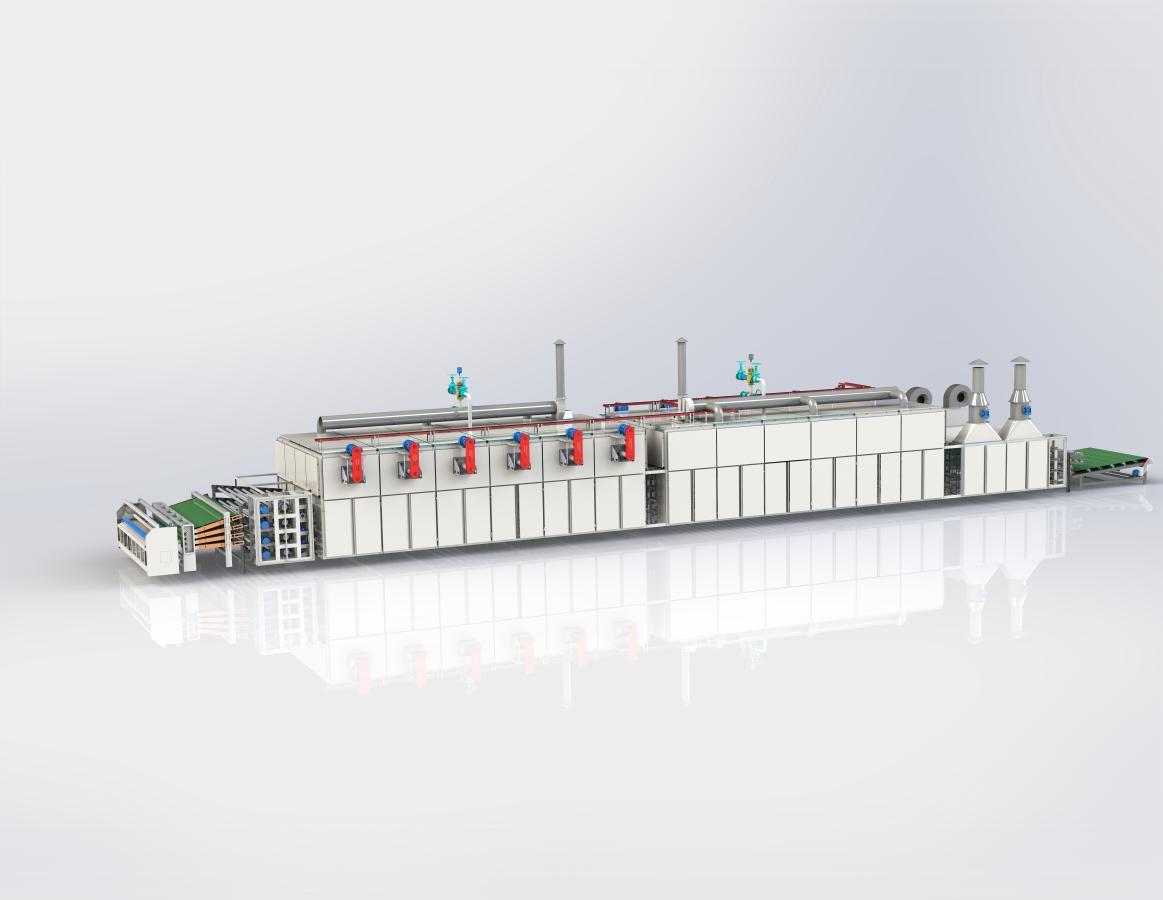
Four deck roller veneer dryer
ELJX-GT-4C-36M · 16 heating sections + 2 cooling sections

Main configuration

Model ELJX-GT-4C-36M
Working width / layers 3100 mm · 4 deck
Heating zone 16 × 2000 mm = 32 000 mm
Cooling zone / nose / tail 2 × 2000 = 4000 mm · 3500 mm · 6500 mm
Transmission speed 1–10 m/min
Heating medium Thermal oil or steam
Heat consumption 3,300,000 kcal (steam 5.5 t)
Drying thickness / capacity 1.5–4 mm · 4.3–5 m³/h
Overall size / weight L 48.1 m × W 6.2 m × H 3.8 m · 126 000 kg

Drive breakdown

Total installed power 246 kW
Transfer motors 7.5 kW × 4 = 30 kW; 3 kW × 1
Heating blower motors 11 kW × 16 = 176 kW
Cooling fans · exhaust 5.5 kW × 4 = 22 kW · 7.5 kW × 2 = 15 kW
Optional: semi-auto feeding / auto laying machine (USD 10,000 in the proposal). Note: heat consumption is copied from the quotation. Check it against the boiler spec before ordering.

Why sort before gluing

Dried veneer is not uniform. Sheets differ in moisture, colour, knots, splits and edge damage. An optical and moisture line sorts every sheet. Clean, even-coloured veneer goes to the face and back. Lower-grade sheet goes into the core, where looks do not matter. Cameras and moisture probes (5–60% range) replace manual judging. The result is a repeatable A/B/C/D grade and stable glue use. Reference 6 · Reference 7

4

Veneer visual & moisture grading / sorting line

8–10 m³/h
Veneer visual and moisture sorting line
Automatic feeding → two-lens inspection → A/B/C/D grading → stacking

Inspection & sorting

Feeding Full automatic
Detection Two-lens, front and back
Sorting efficiency 8–10 m³/h
Grades A / B / C / D or customized
Cameras · monitor 2 · high-definition large screen
Moisture probes / range 4 pcs · 5–60%
AI intelligent system 1 set

Drives

Separate warehouse / subpackage Servo 2.3 kW × 3 · servo 1.5 kW × 4
Lift / conveyor / adsorption VFD 1.5 kW × 2 · VFD 1.5 kW × 7 · 3 kW × 3
Robot arms 6.5 kW × 2
Machine power / working power 53 kW · 13 kWh
Size / weight 21 000 × 8000 × 3200 mm · 10 000 kg
Note: this line is listed in Part 2 but has no separate FOB price in the summary. Confirm it is included in the final contract.
PART 03

Veneer Joining

Turning short strips into full sheets

Scarf and finger jointing

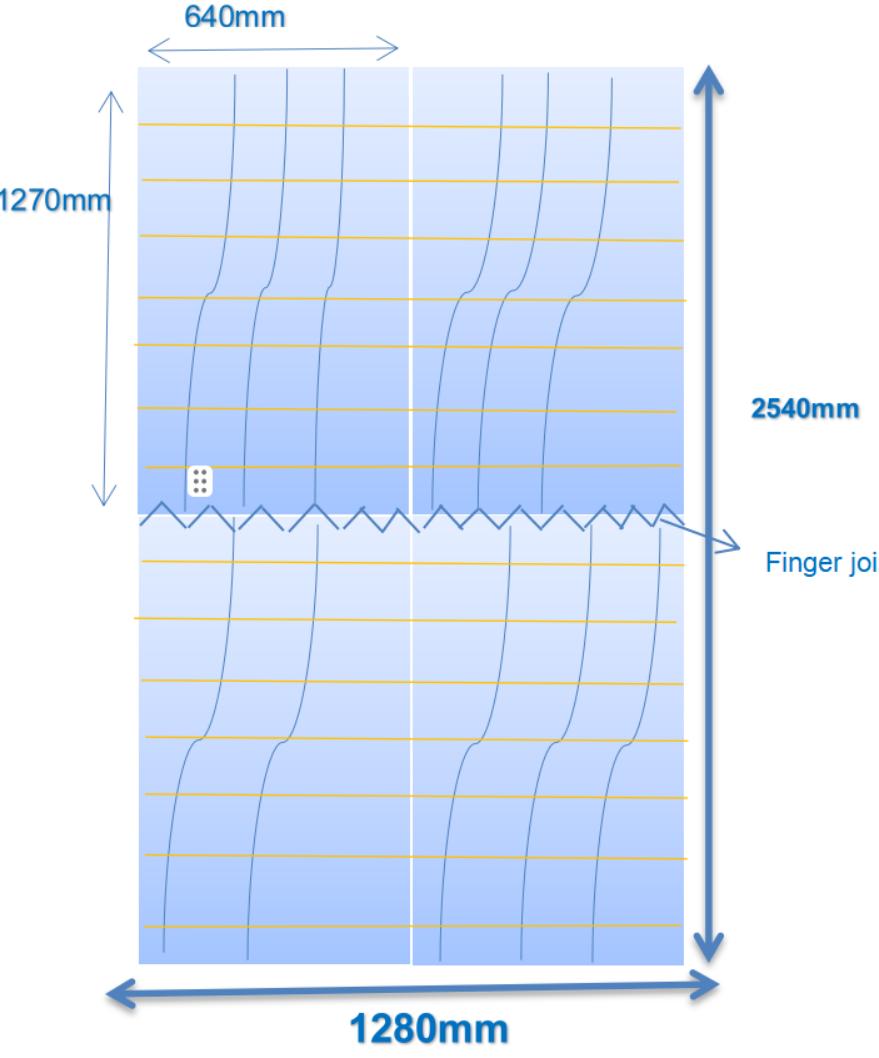
Aim to get more veneer from a log ,usually we peel veneer size into 4x2ft /1300x640mm ,or 4x4ft /1300x1300mm,then we use a fingor joint machine to joint 4x2ft veneer into a full size 8x4ft veneer .the veneer grain is long grain veneer . and we use a core composer to joint 4x2ft to 4x8ft size veneer ,the veneer grain is shor grain . Reference 8 · Reference 9

5

Horizontal veneer composer · 4 × 8 ft short-grain core

300–360 sheets/h
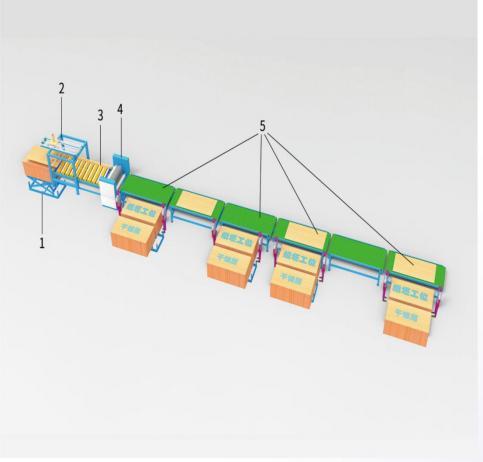
Horizontal veneer composer
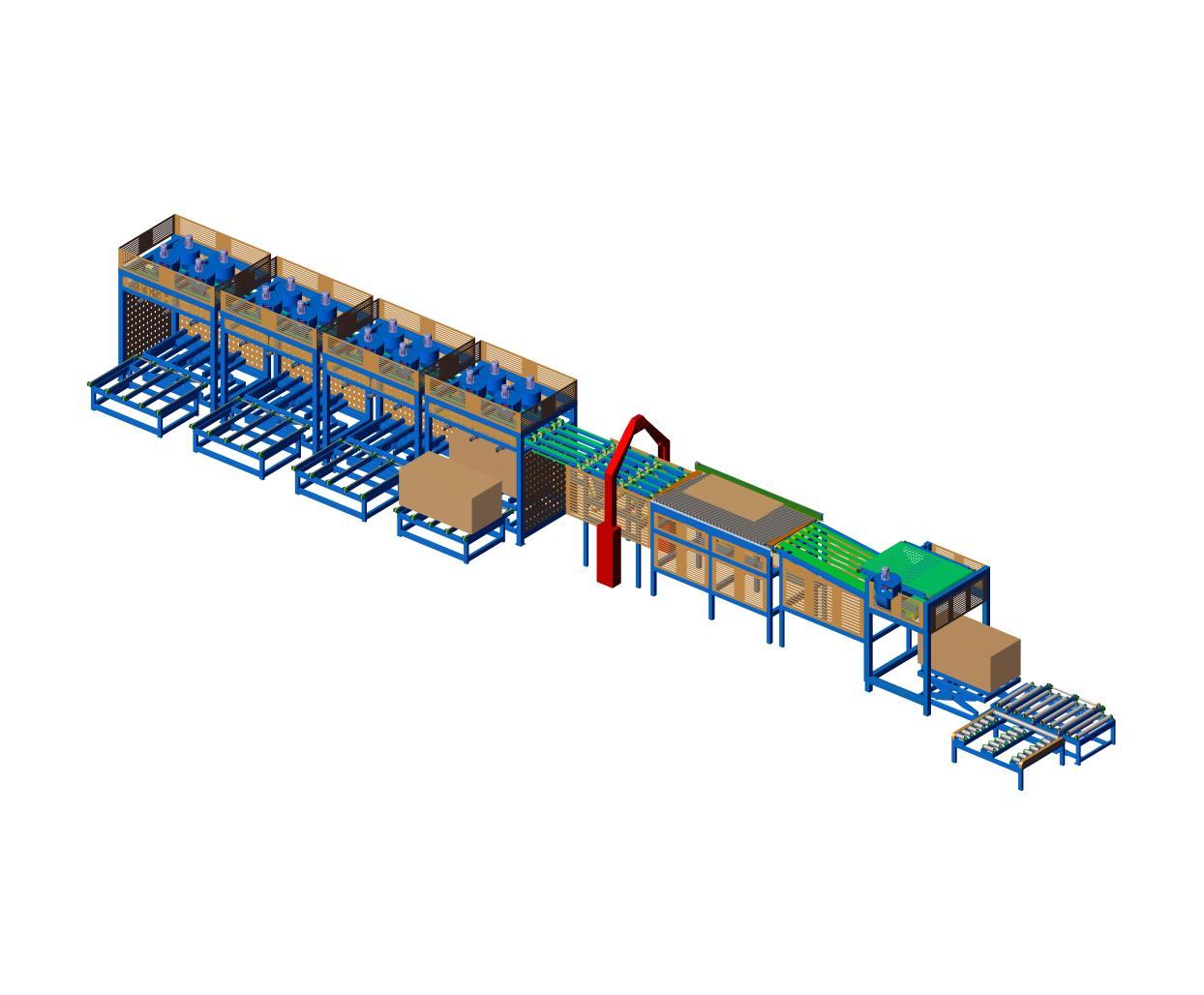
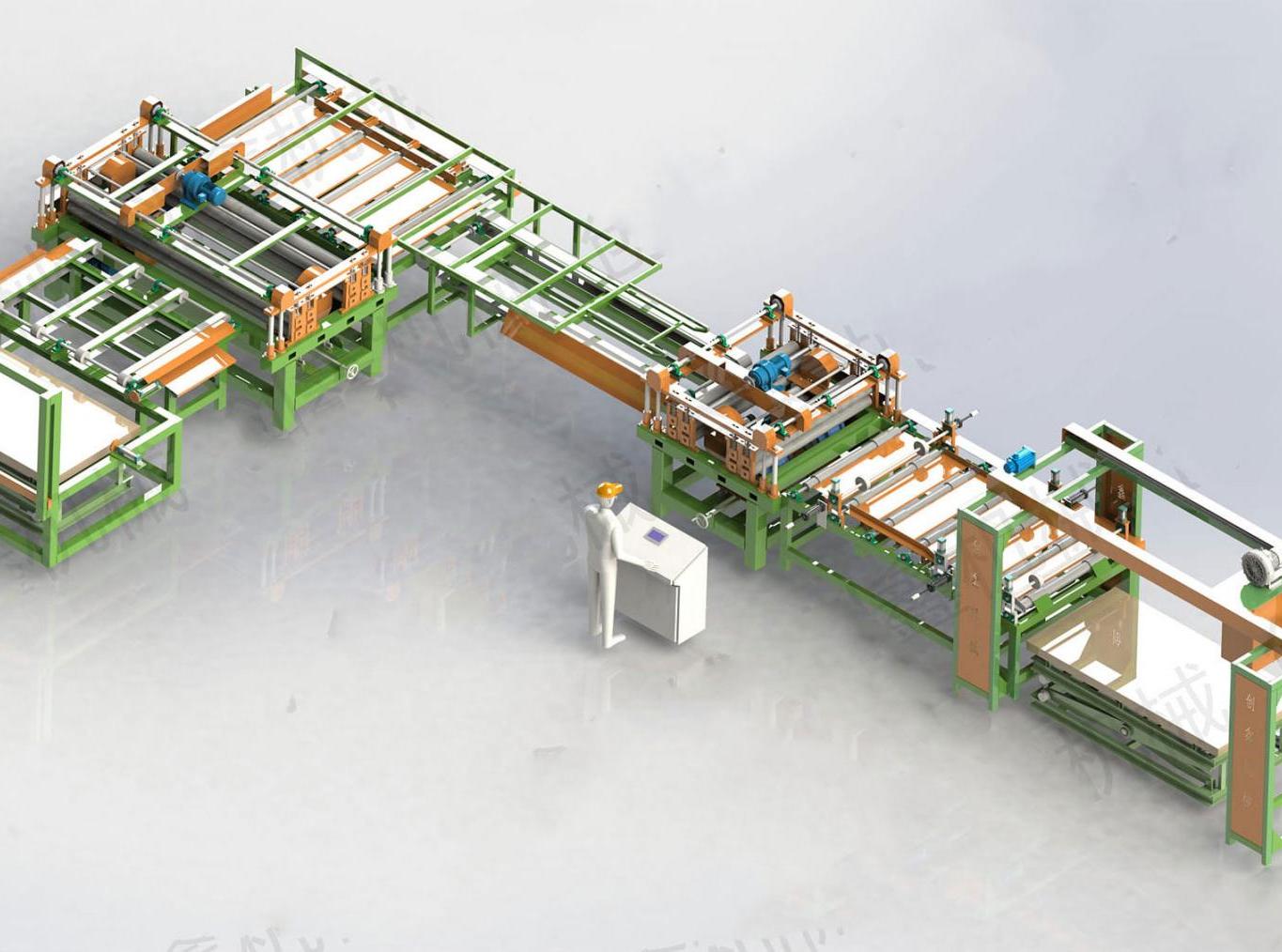
Composing machine and finished-core layout
Short grain composer layout

Performance

Core veneer thickness 1.0–3.6 mm
Jointing direction Horizontal
Transfer speed 0–35 m/min, adjustable
Output 300–360 pcs/h finished
Knife length 1400 mm

Control & drives

PLC / touch screen Taiwan TECO PLC · WECON with remote control
Glue groove heat / AC 9 kW · 1 kW
Front + rear drives, edging, fixed length SINEE servo 3 kW each
Stacker / lift 2.2+2.2, 1.1, 0.75, 3 kW
Total power / weight 35 kW · 5500 kg
Machine size / area 12 500 × 4000 × 2480 mm · 50 m²
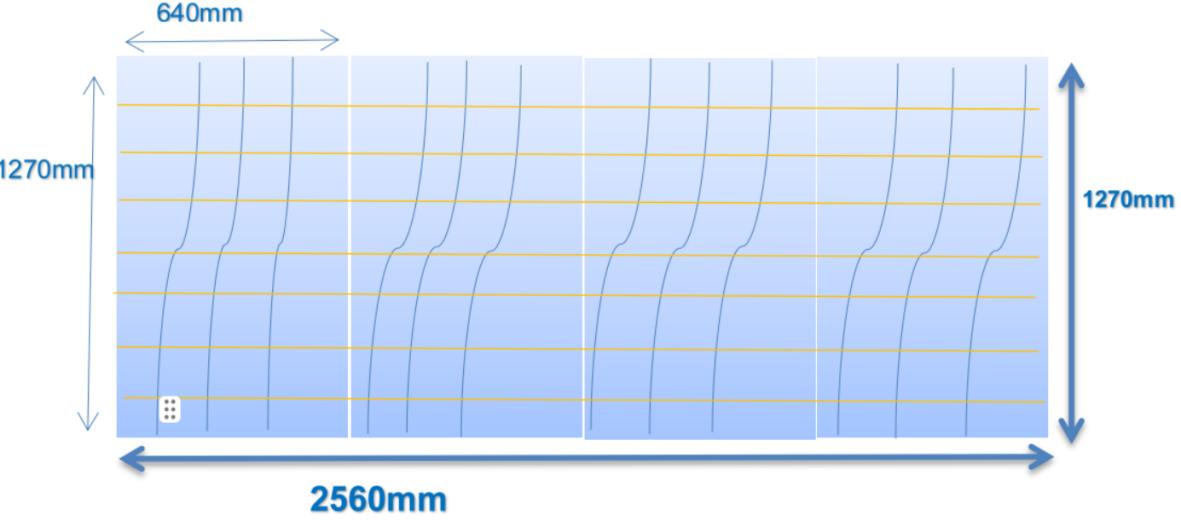
Output: four 1270 × 640 mm strips make one 1270 × 2560 mm core sheet.
6

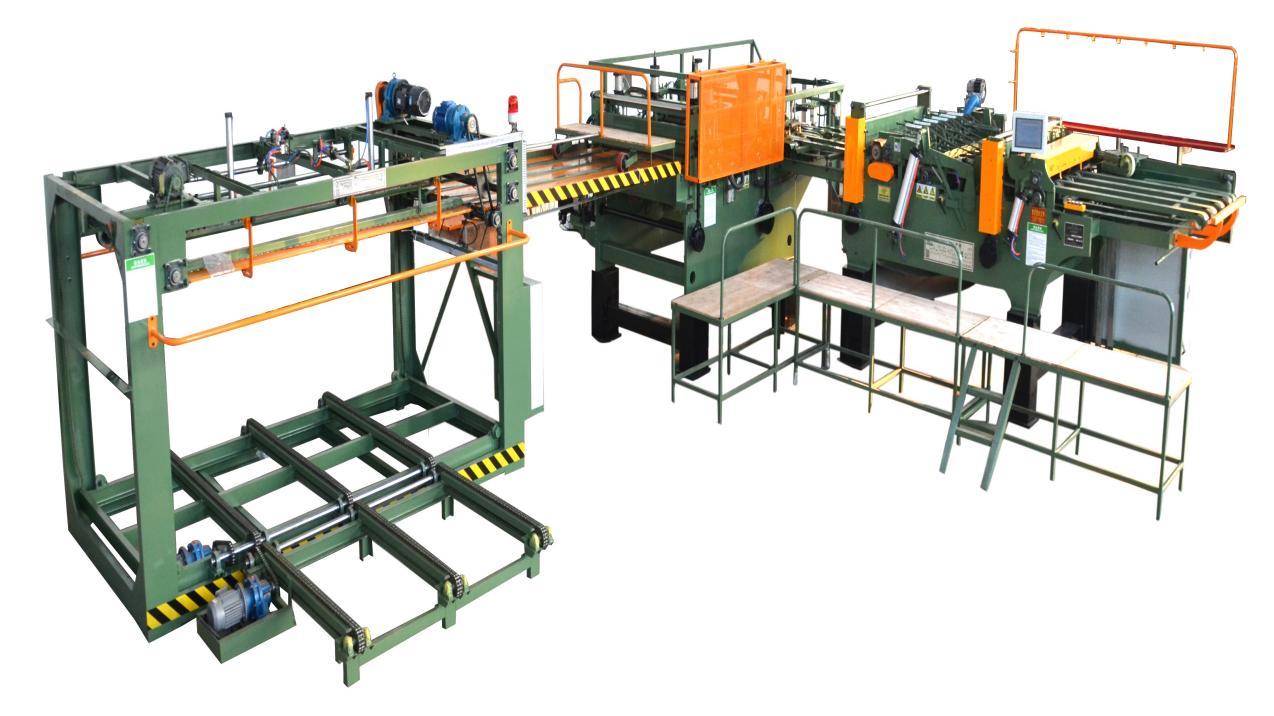
Finger-joint veneer composer · 8 × 4 ft long-grain core

≈ 300 sheets/h
Finger joint veneer composer
Horizontal + vertical finger jointing unit
Finger joint layout

Performance

Jointing direction Horizontal + vertical
Core veneer thickness 1.5–4 mm
Transfer speed / output 0–35 m/min · 300 pcs/h
Finger size / number 30 × 30 mm · 42
Finger-joint plate 16 mm steel

Transverse + vertical sections

Transverse drives SINEE servo 3 kW × 3; edging and fixed-length knives 3 kW each
Transverse glue heat / AC 9 kW · 1 kW
Vertical drives SINEE servo 3 kW × 3
Finger cutting knife / fixed length Hydraulic system 11 kW · hydraulic
Vertical glue heat / AC 7 kW · 1.5 kW
Working tables / vertical knives 4 pcs · 2
Total power / weight 64.6 kW · 9500 kg
Process role: makes 2540 × 1280 mm long-grain core sheets from short veneer pieces.
PART 04

Gluing & Lay-up

Resin application and ply assembly

Glue film and cross-banding

A four-roll glue spreader puts an even resin film on both veneer faces. Application rollers take glue from the pan. Squeeze rollers meter the amount. Gap and speed set the spread (modern lines target ±5 g/m²). Too little glue causes starved glue lines and delamination. Too much adds panel weight, bleed-through and formaldehyde risk. The lay-up station then stacks plies at 90° to each other. This is cross-banding, the reason plywood exists. Face-grade sheets go outside. UF resin suits interior boards; PF/WBP suits exterior and formwork. Reference 10 · Reference 1

7

4 ft glue spreader + lay-up line

≈ 10 m³/h
4 ft glue spreader and lay-up line
Lift table → vacuum feeding → glue spreader → belt conveyors

Line components

Lift table 4 × 8 ft · 3 kW · 9 pcs
Vacuum veneer feeding 3 kW
Roller conveyor 3 m · 2.2 kW

4 ft glue spreader

Roller length / diameter 1400 mm · φ245 mm
Squeeze roller 1400 mm · φ219 mm
Power 3 kW

Transfer

Belt conveyor 3 m × 1.3 m · 6 pcs · 2 kW × 6
Quoted capacity: 10 m³/h. This line feeds the cold press and the two 15-layer hot presses in Part 5.
PART 05

Pressing

Cold pre-press + hot press + film-faced press

Cold press, then hot press

A plywood cold press machine does not replace a hot press. It gives the loose lay-up an initial bond, pushes out trapped air and stops the plies shifting during transfer. Typical settings are 0.8–1.0 MPa for 15–20 minutes. Skip it and you get gaps, misalignment and face bleed after hot pressing. The plywood hot press machine does the permanent job. At 110–150 °C and high pressure, the resin cures and locks the plies into one rigid panel. A 15-opening press cures 15 panels per cycle. Cycle time depends on board thickness, often 5–10 minutes. Reference 1 · Reference 11 · Reference 12

8

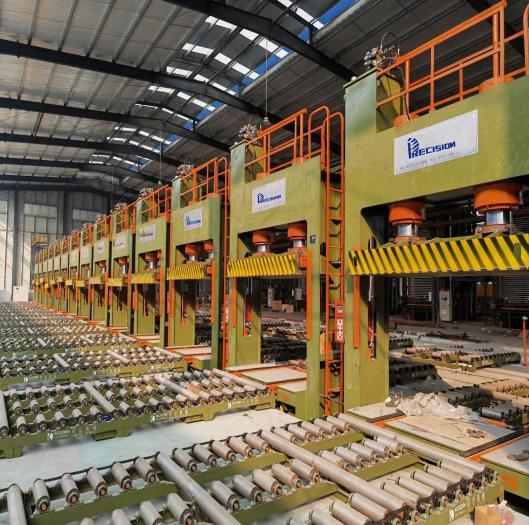
Plywood cold press machine · auto loading

PRSCH4801
Automatic cold press machine
Cold press line with roller conveyor and automatic loading

Press specification

Model PRSCH4801
Pressure 400 t
Working table 2700 × 1370 mm
Layer space 1800 mm
Cylinder φ320 × 1050 mm · 2 pcs
Power / platen thickness 13 kW · 35 mm
Weight / size 14 t · 4000 × 1700 × 4300 mm
Process role: pre-presses the glued mat so it can be moved into the hot press without shifting.
9

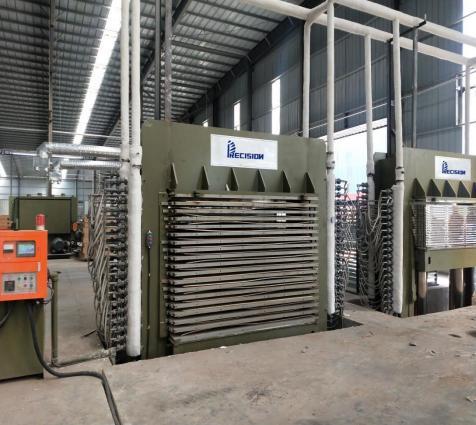
Plywood hot press machine · 15 layer · 600 t

2 units · 30 pcs/h each
15 layer 600 ton hot press machine
15-opening hot press with side loading system

Press specification

Nominal pressure 600 t
Hot platen 1370 × 2700 × 42 mm
Cylinder / opening φ320 × 2 pcs · 70 mm
Closing time 15 s
Power 33 kW
Capacity 30 pcs/hour per machine
Size / weight 3200 × 2000 × 4800 mm · 33 t
Line output: two machines give 60 panels/hour. This matches the stated line rating.
10

Film-laminated hot press machine · 15 layer

Construction formwork
Film laminated hot press machine
15-layer press configured for film-faced plywood

Frame & platens

Frame Composite frame; upper support 1000 mm, lower 900 mm, middle 400 mm
Frame steel 30 mm legs, 370 mm × 8 pcs, all planed
Opening / hot platen 100 mm · 1370 × 2700 × 42 mm
Platen circuit Double inlet / double outlet, balanced heating
Platen machining 16 pcs, CNC lathe, flatness deviation < 0.02 mm

Hydraulic & heating

Cylinders φ260 mm · 6 pcs · Chenfeng, Wuxi; cast steel body, alloy plunger
Working pressure 26 MPa
Hydraulic system Anti-pollution station, superior valves, high-performance vane pump
Heating medium Heat-conductive oil / steam
Motors Low-pressure pump motor 22 pcs as written in quote; high-pressure pump 4 kW
Included in the quote: stainless steel plates × 30, cushion pads × 30, lifter table. Note: the "22 pcs" motor entry is copied from the quotation. Confirm the motor rating before signing.

What the film press adds

A film-faced panel is formwork board with a phenolic film or melamine paper bonded to the surface during pressing. The film gives a smooth, water-resistant, easy-release face. It can be reused for several concrete pours. Platen flatness and even heat decide whether the film bonds without bubbles or shiny spots. A double-in/double-out platen circuit and tight flatness tolerance (below 0.02 mm here) are the usual specs for this job. Reference 13

PART 06

Panel Trimming

Four-edge sizing after pressing
11

Plywood edge trimming saw · auto loading

400–600 pc/h (machine)
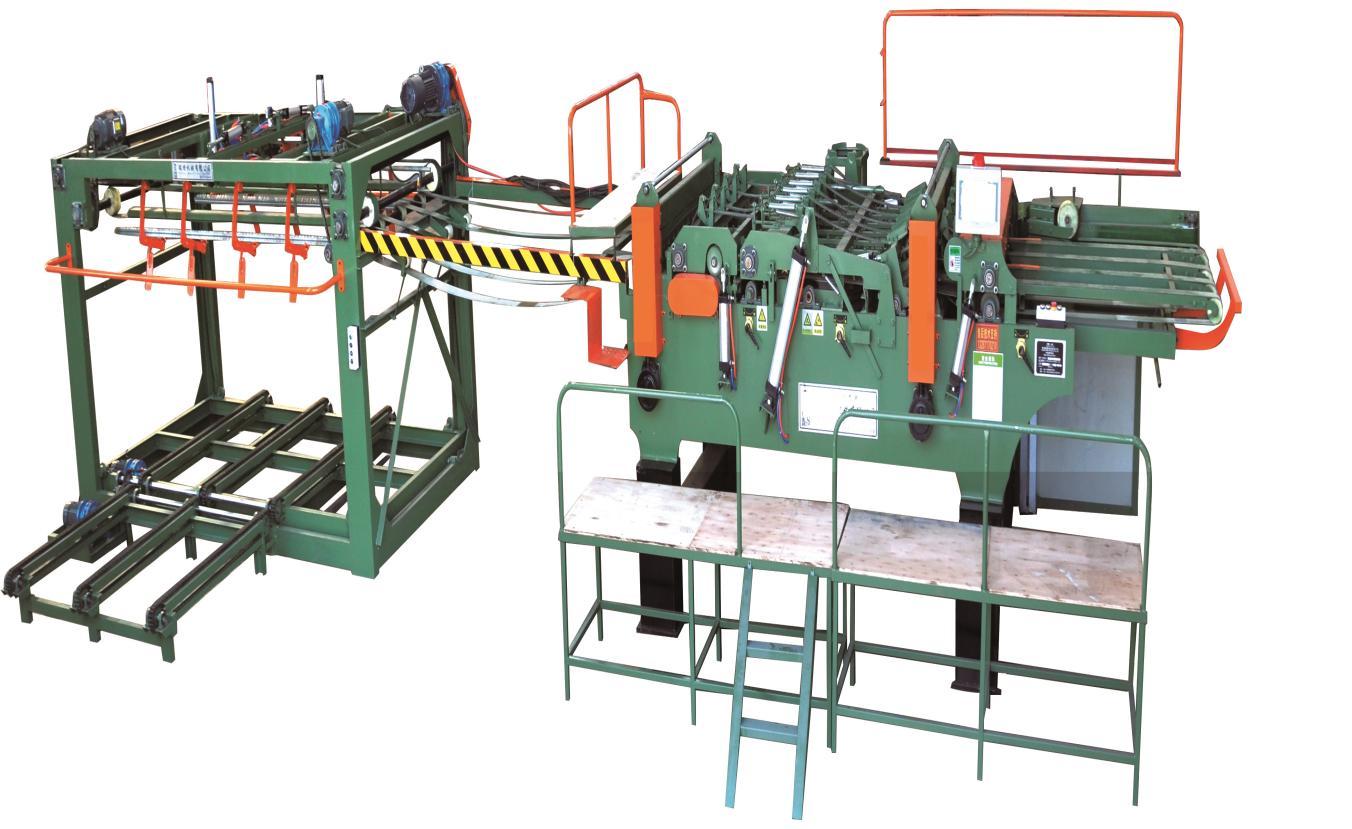
Roller type edge trimming saw line
Longitudinal + cross trimming with roller conveyors

Cutting range

Panel before sawing 2440–2550 mm L × 1220–1300 mm W
Finished size Customized
Panel thickness 5–40 mm
Capacity 400–600 pc/h (machine rating)

Accuracy & power

Linear allowance ≤ 0.3 mm
Diagonal allowance ≤ 1 mm
Total power 50 kW
Why it matters: pressed panels come out oversized and uneven. Twin-blade trimming sizes all four edges in one pass. Buyers check diagonal error first. It decides whether panels can be cut and installed without waste. Reference 14
PART 07

Calibration Sanding

Final thickness and surface

Calibration vs polishing

Calibration sanding is a heavy cut (0.3–1 mm). It removes thickness variation left by the press and brings the panel to a tight tolerance, usually ±0.1 mm. Polishing sanding is a light pass (0.05–0.2 mm). It removes glue spots, fuzz and burrs before painting or laminating. Wide-belt machines use 320 mm contact rollers and coarse belts for calibration. Dust extraction is a must: resin sanding dust quickly fouls belts and bearings. Reference 15 · Reference 16

12

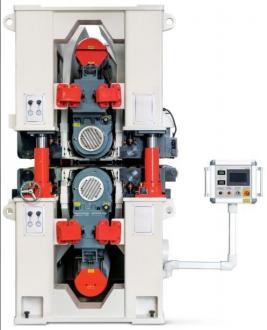
Plywood sanding machine · calibration · auto loading

600–1700 mm width
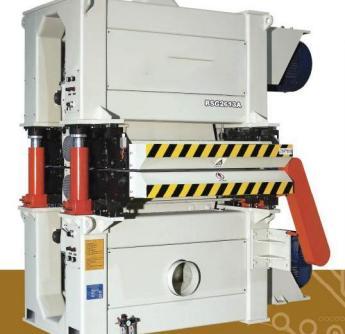
Calibration sanding machine
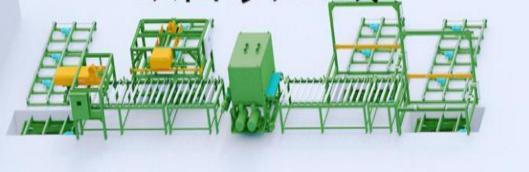
Wide-belt sander and vacuum loading / unloading system
Sanding machine front view Vacuum loader for sanding line

Working range

Sanding width / thickness 600–1700 mm · 1–80 mm
Abrasive belt speed / size 25 m/s · 1730 × 2800 mm
Transport speed 6–30 m/s as written in quote
Voltage 220 V · 60 Hz as written in quote

Drives & utilities

Main motors / reducer 75 kW × 2 · 4 kW
Lift / brushing 0.75 kW · 0.37 kW
Total motor / pressure 60.12 kW · 0.6 MPa
Dust extraction / rollers 26 000 m³/h · steel rollers 320 + 320 mm
Size / weight 2900 × 2200 × 2360 mm · 12 000 kg
Verify before order: the quote lists main motors of 75 kW × 2 but a total of 60.12 kW. It also gives 220 V / 60 Hz and transport speed in m/s. Check these against the final machine drawing and the buyer's power supply. Optional: vacuum loading + unloading system (USD 10,000 in the proposal).
OPTIONAL

Workshop Support Equipment

Not included in the 12 main machines

Plant balancing

The quoted line rating is 60 panels/hour. The two 600 t hot presses set this (30 pcs/h each). Upstream capacity: 2 m³/h face veneer + 3 m³/h core veneer, 5 m³/h drying, 10 m³/h gluing. Downstream trimming and sanding are rated 200 pcs/h in the summary. The support machines below handle material flow, knife care, glue mixing and waste disposal. Small items, but the plant stops quickly without them.

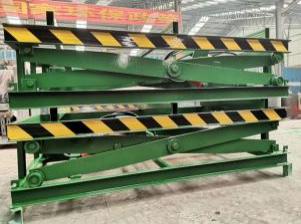
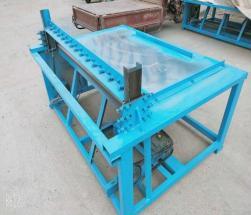
X lifter
1 · X lifter
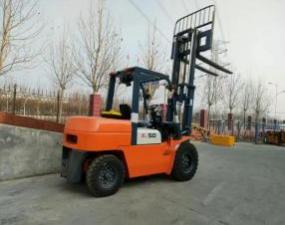
3 ton forklift
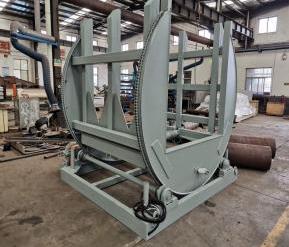
2 · plywood turnover machine
Veneer clipper
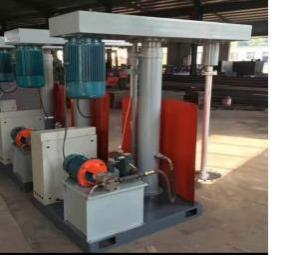
3 · Glue mixer
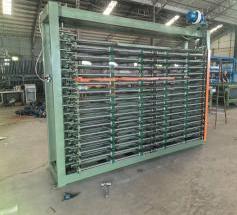
Cooling pallet
4 · 3 tons forklift
Plywood turnover machine
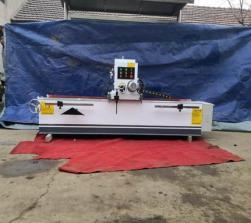
5 · Knife grinding machine
Glue mixer
6 · veneer clipper
Knife grinding machine
7 · Cooling pallet
4 ton wood chipper
8 · Wood chipper · 4 t

Waste loop

The wood chipper closes the loop. Peeler cores, trim offcuts and rejected veneer are chipped and used as biomass fuel for the dryer's thermal-oil boiler. This offsets a large part of heating cost. Knife grinding and glue mixing are also in-house jobs. A dull peeling knife changes veneer thickness across the whole line. Glue mixed to the wrong viscosity makes the spreader meter inaccurately.

PROJECT

Line Capacity & Commercial Terms

As stated in the quotation
2 + 3 m³/h face + core peeling
5 m³/h veneer roller dryer
10 m³/h glue spreader + lay-up
60 pcs/h 2 × 600 t hot presses
200 pcs/h trimming & sanding
Delivery time 4 months
Payment 30% deposit, 70% balance before shipment
Installation Buyer covers air tickets, hotel and local freight, plus USD 100/day/person. All machines require 5 persons × 3 months.
Warranty 12 months from completion of installation, except human-caused damage
Contact PRECISION · Linyi Precision Machinery Co., Ltd. · serenda@prsplywoodmachine.com · WhatsApp +86-15580858117 · www.prsplywoodmachine.com
Previous: 
Next: 

Related Products

content is empty!

Related News

Contact Us For Price

Linyi Precision Machinery company is a top manufacturer of plywood machine, more than 15 years.

Quick Links

Product Category

Contact Us

  +86-155-8805-8177  
      +86-155-8809-8150
  Economic development zone, Feixian, Linyi,shandong, China

Copyright © 2026 Linyi Precision Machinery Co.,Ltd. All Rights Reserved. | Sitemap