
Hand phone / Whatsapp
+86-155-8805-8177
Views: 0 Author: Site Editor Publish Time: 2026-10-26 Origin: Site


In continuous manufacturing environments, overall facility throughput strictly depends on the single slowest process step. Ignoring this principle leads to misallocated capital and unrealized capacity. Plant managers often struggle to distinguish between temporary process variability—like operator absence or raw material defects—and systemic plywood production line bottlenecks that permanently cap daily yield. From the initial log to the final panel, manufacturing plywood involves highly interdependent stages. Upstream variability in log storage, debarking, log heating, and veneer peeling frequently cascades down the line. This masks the true constraints. Moving from symptom identification to targeted capital expenditure requires a rigorous evaluation of specific machinery upgrades. You must examine everything from drying to finishing. This ensures new equipment directly elevates the facility's baseline capacity and delivers measurable operational improvements.
Constraint Identification: True bottlenecks are characterized by consistent upstream inventory accumulation and downstream idle time, not just localized machine downtime.
Intentional Management: Bottlenecks persist when management attention is spread evenly across the floor instead of being intentionally focused on the primary constraint.
Automation as a Multiplier: Replacing manual or semi-manual processes with automated systems (e.g., layup lines, automatic presses) reduces cycle time variance and labor dependency.
Quality vs. Speed Trade-offs: Debottlenecking must not compromise product integrity; upgrades in gluing and pressing must maintain strict tolerances for moisture, adhesive spread, and thermal transfer.
Integration Realities: Evaluating new machinery requires assessing the downtime required for installation, PLC integration compatibility, and the learning curve for existing operators.
The Theory of Constraints dictates that any manufacturing system is limited by at least one constraining process. In wood processing, your factory only produces as much plywood as your slowest machine allows. Optimizing non-bottleneck machines does not increase sellable yield. It merely creates excess work-in-progress inventory. This ties up working capital and clutters the factory floor with stacks of unprocessed veneer.
A significant planning gap occurs when capacity models ignore inherent material variability. Wood is a natural product. Moisture content, density, and log geometry fluctuate constantly. These natural variations cause processing times to shift continuously throughout a single shift. When management attention spreads evenly across all departments, the primary constraint receives insufficient focus. Constraint-led flow decisions are necessary. You must identify the exact machine dictating the pace and focus all optimization efforts there.
Before upgrading machinery, you must establish clear baseline metrics. Track Overall Equipment Effectiveness (OEE) rigorously. Measure cycle times per phase and document scrap rates accurately. These metrics reveal whether a machine truly holds back production or just experiences poor maintenance. Data collection should span multiple shifts to account for operator differences and ambient temperature changes.
Define the financial threshold for equipment upgrades clearly. Compare the capital expenditure against projected operational expense savings and revenue gains. An upgrade only makes sense if it increases the total throughput of the entire line. If a new machine simply moves the bottleneck to the next station without increasing final output, the investment fails. Calculate the exact volume of additional panels required to justify the mechanical upgrade.
To properly evaluate a constraint, follow these field-tested steps:
Log machine idle times across three consecutive shifts to identify patterns.
Measure the physical footprint of staged inventory before each major machine center.
Calculate the exact cycle time variance for manual versus automated tasks.
Audit maintenance logs to separate mechanical failure downtime from process-induced waiting time.
Drying historically represents one of the most severe constraints in panel manufacturing. Upstream variability heavily impacts drying cycle times. Inconsistent log heating and fluctuating veneer peeling thicknesses force operators to alter drying parameters constantly. When wet veneer stacks up before the dryer while the layup line waits, you have a definitive constraint.
Manual feeding creates significant operational drag. Uneven heat distribution within older dryers leads to inconsistent moisture profiles across the veneer sheets. High-moisture raw logs frequently require redrying. This double-handling slashes throughput and increases thermal energy waste. Every time a sheet of veneer passes through the dryer twice, you lose the opportunity to dry fresh material.
Upgrading to an automatic veneer drying line directly addresses these inefficiencies. Continuous roller systems keep veneer flat, preventing cracking and warping during moisture evaporation. Automated moisture detection systems adjust feed speeds dynamically. This ensures optimal thermal transfer and eliminates the need for manual redrying passes. The machine adapts to the wood, rather than forcing operators to guess the correct speed.
Scalability is a primary evaluation factor for thermal equipment. Modern drying lines feature modular sections. You can add heating zones later to expand capacity without replacing the entire unit. This modularity allows your drying capacity to grow alongside your business. Thermal fluid systems operate at higher temperatures without the massive pressure requirements of steam, allowing for faster moisture evaporation. However, they require specialized pumps and strict maintenance protocols to prevent fluid degradation.
Implementation carries specific risks that require careful planning. You must evaluate footprint requirements carefully. Ensure compliance with local exhaust and emissions regulations. Verify that your facility possesses the energy infrastructure necessary to support high-capacity thermal fluid or steam heaters. Inadequate boiler capacity renders a new dryer completely ineffective. For instance, if your current boiler outputs 2,000,000 kcal/h but the new dryer requires 3,500,000 kcal/h to maintain 180°C in the heating zones, the dryer will never reach optimal feed speeds. You will end up with wet veneer and a massive capital expenditure that fails to deliver returns.
Adhesive application dictates both product quality and operational costs. Manual or outdated spreaders lead to excessive adhesive consumption. This drives up operational expenses significantly. Conversely, insufficient coverage causes delamination and immediate product rejection. Finding the perfect balance is impossible with worn mechanical components.
A hidden bottleneck emerges during routine maintenance. When the layup team must wait for the spreader to be cleaned, recalibrated, or repaired, the entire downstream process halts. Glue spread variability forces operators to slow down the line to manually inspect and correct adhesive distribution. This manual intervention destroys production rhythm and introduces human error into a chemical process.
Replacing outdated equipment with a modern plywood glue spreader stabilizes the assembly phase. Standard double-roller spreaders often struggle with viscosity changes as ambient temperatures shift. Viscosity changes throughout the shift as the resin mix begins to catalyze in the holding tank. Advanced four-roller systems feature independent variable speed drives. They provide exact control over the glue line thickness, regardless of environmental conditions. A modern spreader with chilled rollers can extend the pot life of the adhesive, preventing premature curing on the applicator rolls.
When evaluating spreaders, look for precise gap adjustment mechanisms. Ease of roller cleaning is vital for downtime reduction. Ensure the machine is compatible with various adhesive viscosities, including UF, PF, and MUF resins. The doctor rollers must maintain strict parallel alignment with the applicator rollers to guarantee uniform spread rates.
Weigh the upfront cost of a high-precision spreader against daily operational savings. Accurate application reduces resin waste immediately. It also minimizes scrap rates caused by poor bonding. Over a single fiscal year, the reduction in chemical waste often covers the capital cost of the machinery. A plant running 50 cubic meters per shift can waste up to 15% of its daily resin budget through over-application. A four-roller system dials the spread rate down to the exact gram per square meter required by the resin manufacturer.
The layup phase is traditionally the most labor-intensive stage in panel manufacturing. Manual veneer alignment is inherently slow and physically demanding. It causes high ergonomic strain on workers. This leads to fatigue, which inevitably results in inconsistent core gaps or overlaps. As the shift progresses, manual assembly speed drops dramatically.
Layup speed directly dictates the utilization rate of the downstream hot press. If the press sits open waiting for assembled panels, valuable curing time is lost. Labor dependency here creates unpredictable cycle times. This makes accurate production scheduling impossible and forces managers to overstaff the assembly line to guarantee press utilization.
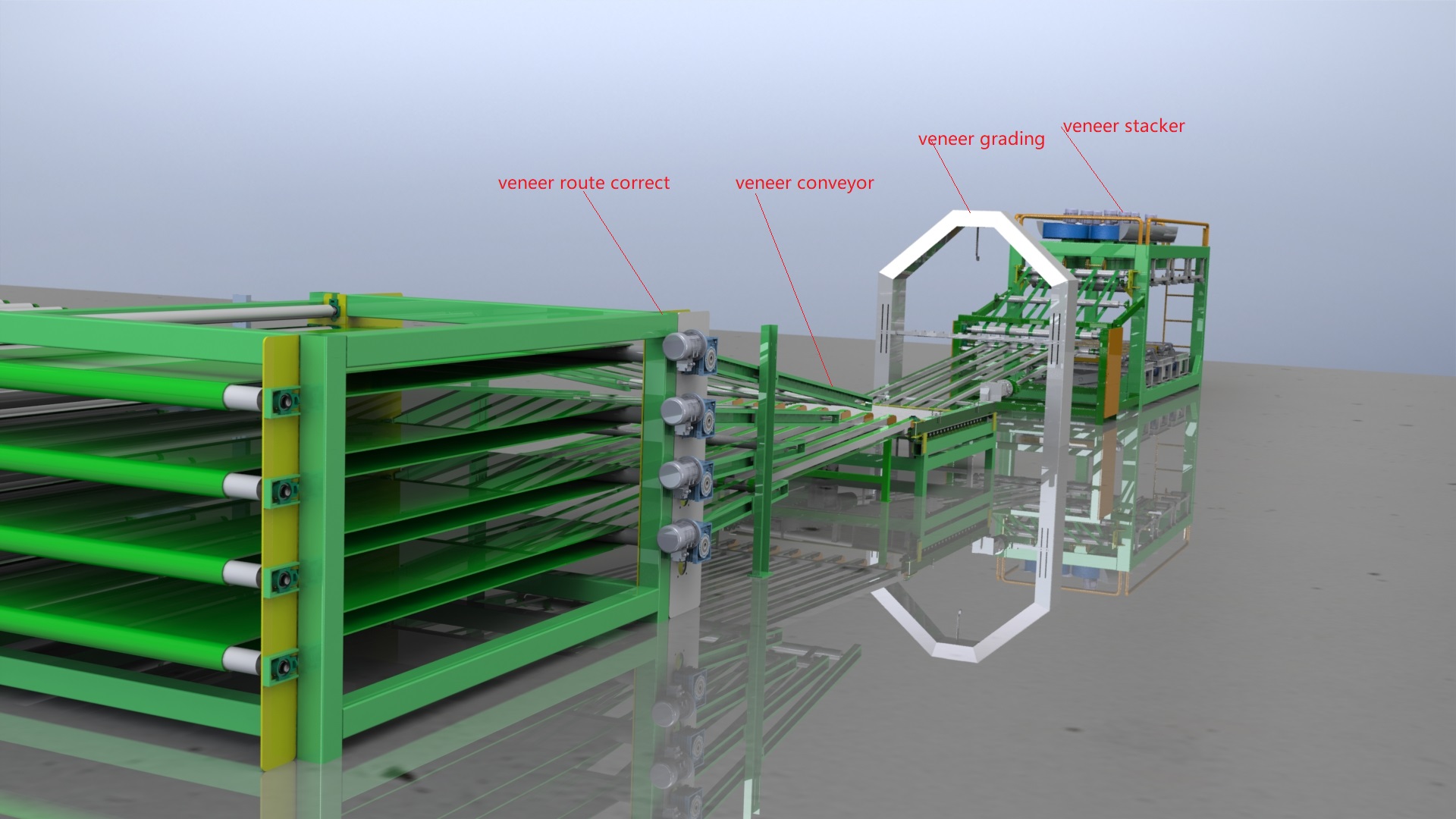
Transitioning to a plywood veneer layup line transforms this manual bottleneck into a synchronized, continuous flow. Automated core composing and precise edge alignment eliminate human error. Continuous conveyor feeding reduces cycle times drastically and lowers labor overhead. The machine dictates the pace, ensuring a steady supply of pre-pressed panels.
Assess the system's ability to handle varying veneer thicknesses and grades. The best lines accommodate material variations without requiring frequent mechanical adjustments. Look for robust optical sensors that detect voids and overlaps instantly. The system should automatically reject defective core layers before they reach the pressing stage.
Consider the implementation risks regarding personnel. Operators must transition from manual handling to managing PLC-controlled synchronization. Adequate training prevents new technology from becoming a different type of constraint. Your maintenance team must also understand the pneumatic and servo-driven components powering the automated layup process. For example, if a servo motor faults on the core composer, a mechanic used to fixing chain drives might spend hours troubleshooting. Upgrading machinery means you must also upgrade your maintenance department's electrical troubleshooting skills.
The pressing stage is where the product takes its final structural form. However, dead time severely limits daily output. Minutes are lost during manual loading, unloading, and pressure stabilization. Every second the press remains open, thermal energy escapes into the factory air, cooling the platens.
Uneven platen temperatures further complicate the process. Poor thermal transfer forces operators to extend press cycles to ensure adequate core bonding. This artificial extension of curing time drastically reduces the number of batches processed per shift. When the press becomes the bottleneck, the entire upstream factory must slow down to prevent staging areas from overflowing.
An automatic loading plywood hot press eliminates manual loading delays entirely. Simultaneous multi-daylight loading and unloading cages reduce press open-time to mere seconds. This maximizes actual curing time and maintains consistent platen temperatures. The automated pushers slide raw panels in while simultaneously ejecting cured panels.
Evaluate the hydraulic system reliability carefully. Analyze platen thickness, machining tolerances, and thermal fluid flow dynamics. Robust construction ensures uniform pressure and heat distribution across all daylights. The hydraulic pumps must deliver rapid closing speeds followed by precise, high-pressure holding phases. Different wood species require specific pressing parameters. Softwoods might compress too much under 14 kg/cm², while dense hardwoods require that exact pressure to achieve proper consolidation. Automated presses allow for programmable pressure curves that adjust dynamically during the curing cycle.
The primary value consideration is the trade-off between capital cost and output. Automated loading systems require significant investment. However, they offer an exponential increase in daily board output. By eliminating dead time, you can often process three to four additional press loads per shift, drastically improving facility profitability. Consider a 15-daylight press. Manual loading might take 4 minutes. Unloading takes another 3 minutes. That is 7 minutes of dead time per cycle. Over a 10-hour shift running 15-minute cure times, you lose hours of potential pressing capacity. Automation reclaims that time.
Finishing operations often force a compromise between speed and quality. Older calibrating and sanding machines require slow feed speeds. Pushing them faster results in chatter marks, snipe, or abrasive belt burning. Operators are forced to run the machines well below their theoretical capacity to maintain acceptable surface grades.
A severe bottleneck occurs when boards require multiple passes to achieve the required thickness tolerance. Double or triple handling at the sander cuts finishing throughput by more than half. This causes finished panels to pile up before the packaging station. It also accelerates wear on the abrasive belts, increasing consumable costs.
Integrating a heavy-duty plywood sanding machine enables single-pass processing. Multi-head configurations typically feature a calibrating roller followed by combination heads and finishing pads. This setup achieves exact thickness tolerances and fine surface finishes simultaneously. A typical single-pass setup utilizes a 60-grit steel calibrating roller, followed by an 80-grit rubber roller, and finishes with a 120-grit segmented pad. This sequence removes up to 2mm of material while leaving a surface ready for lamination or coating. The heavy cast-iron frame absorbs vibration, allowing for much higher feed speeds.
Assess motor horsepower, belt tracking automation, and dust extraction efficiency. Powerful motors prevent the heads from bogging down under heavy loads. Automated pneumatic tracking extends abrasive belt life and prevents catastrophic belt breakage during high-speed operation.
Upgrading finishing equipment necessitates infrastructure checks. You must upgrade the facility's dust collection infrastructure to handle increased extraction volumes. High-speed sanding generates massive amounts of fine particulate matter. Compliance with combustible dust safety standards is non-negotiable to prevent severe fire and explosion hazards. A modern three-head sander running at 25 meters per minute requires extraction velocities exceeding 4,500 feet per minute at the port. If your current baghouse cannot pull that volume, dust will build up on the abrasive belts, causing premature loading and ruining the panel finish.
Implementing effective plywood factory production solutions requires holistic line synchronization. You must make constraint-led flow decisions. Ensure the throughput capacities of newly upgraded machines perfectly match existing upstream and downstream equipment. A massive new hot press is useless if the drying line cannot supply enough veneer to feed it.
Buffer zones play a critical role in maintaining continuous flow. Pre-press staging areas and post-dryer cooling racks absorb minor machine faults. They prevent localized downtime from stopping the entire production line. Proper buffer sizing requires calculating the mean time between failures for each major machine center.
Production Phase | Common Bottleneck Symptom | Automated Equipment Solution | Primary Operational Benefit |
|---|---|---|---|
Veneer Drying | High redry rates, manual feeding delays | Automatic Veneer Drying Line | Continuous moisture control, zero redrying |
Gluing | Excessive resin waste, delamination | Precision 4-Roller Glue Spreader | Exact coat weight, reduced chemical costs |
Assembly | Slow manual alignment, core gaps | Automated Veneer Layup Line | Synchronized pacing, reduced labor overhead |
Pressing | Long load/unload times, thermal loss | Auto-Loading Hot Press | Maximized curing time, uniform heat transfer |
Finishing | Multiple passes required, chatter marks | Heavy-Duty Multi-Head Sander | Single-pass calibration and finishing |
Selecting equipment manufacturers requires strict criteria. Prioritize vendors offering immediate availability of spare parts and robust remote diagnostic capabilities. When a PLC faults, you need a technician who can dial into the machine remotely to troubleshoot the code. Proven installation timelines are essential for minimizing factory disruption.
Mitigate installation downtime through phased commissioning. Conduct rigorous factory acceptance testing (FAT) before the equipment ships. This ensures the machinery meets all performance specifications before it arrives on your floor. Require the vendor to run your specific wood species and adhesive types during the FAT to guarantee real-world performance. Do not accept a FAT run on perfectly conditioned birch if your factory processes high-moisture pine. The machine must prove it handles your actual daily raw material variations.
Deploy sensors on your primary machine centers to log active versus idle time over a 14-day period to isolate the true factory constraint.
Audit your current boiler and dust extraction capacities to verify they can support the increased demands of automated drying or sanding equipment.
Request detailed technical specifications and performance guarantees from equipment manufacturers based on your specific wood species and daily volume targets.
Schedule a phased installation plan with your chosen vendor to minimize production downtime during the equipment commissioning phase.
A: Look for the machine that consistently has a buildup of work-in-progress inventory upstream and idle operators or machines downstream. Data logging of machine active versus idle time will isolate the true constraint. The bottleneck is the stage dictating the maximum daily output.
A: Depending on local energy costs and the reduction in redry rates, facilities typically see an ROI within 18 to 36 months. This rapid return is driven by increased thermal efficiency, reduced veneer waste, and higher downstream throughput.
A: Yes. Uneven glue spread requires longer press times and higher pressures to ensure adequate bonding. A precision spreader applies an exact, uniform coat weight. This allows for optimized, shorter press cycles and prevents steam blisters.
A: Beyond the physical footprint and ceiling height for the loading cages, facilities must ensure adequate electrical supply for the hydraulic pumps. You also need sufficient boiler or thermal fluid heater capacity to maintain consistent platen temperatures under continuous operation.
A: Automated layup lines eliminate human error in veneer placement. They utilize optical sensors and precise mechanical alignment to ensure consistent core gaps, prevent overlaps, and reduce the incidence of internal voids or delamination in the finished panel.
A: High-speed, multi-head sanders generate significantly more particulate matter than older models. Inadequate dust extraction leads to abrasive belt loading, poor surface finish, and severe fire or explosion hazards. Upgraded extraction maintains safe air velocities.
