
Hand phone / Whatsapp
+86-155-8805-8177
Views: 0 Author: Site Editor Publish Time: 2026-11-02 Origin: Site


Rising labor costs, stricter quality tolerances, and the need for higher throughput force mill operators to critically evaluate their manufacturing infrastructure. The evolution of plywood machinery has shifted the industry from isolated, labor-intensive workstations to highly synchronized, data-driven manufacturing ecosystems. Balancing upfront capital expenditure with long-term operational efficiency is the core problem when deciding how far to automate a facility. Over-automating can lead to inflexible production and high maintenance overhead, while under-automating leaves a mill vulnerable to labor shortages and inconsistent panel quality. To make an evidence-based decision, plant managers must objectively compare a semi automatic vs fully automatic plywood line across specific production stages, evaluating throughput requirements, workforce capabilities, and facility constraints.
Fully automatic lines drastically reduce labor dependency and increase yield consistency, but require high initial CAPEX, linear floor space, and specialized maintenance personnel (PLC/CNC technicians).
Semi-automatic configurations offer greater production flexibility and lower upfront costs, making them ideal for mills with variable product runs, custom panel sizes, or lower volume targets.
A phased plywood production line upgrade—such as integrating an automatic veneer layup line or an automatic plywood hot press machine into an existing manual flow—often yields the highest immediate ROI while mitigating implementation risks.
The semi-automatic workflow relies on mechanized processing at individual stations, such as peeling lathes, cold presses, and sanding machines. It fundamentally depends on manual intervention or forklift transfers to move materials between these isolated zones. Workers physically load veneers into dryers, manually align core layers during glue application, and transport stacked panels to the pressing department. Forklift traffic dominates the factory floor, requiring wide aisles and constant safety monitoring.
From a technical standpoint, this approach presents a lower barrier to entry. Semi-automatic machinery typically utilizes standard relay logic, basic contactors, and simple variable frequency drives (VFDs). Maintenance teams troubleshoot mechanical failures without requiring advanced engineering support or specialized diagnostic software. If a single machine goes down, operators bypass the bottleneck temporarily by routing material to a backup station, keeping other parts of the mill running.
This configuration excels in high-mix, low-volume production environments. Mills that frequently change panel dimensions, thicknesses, or face veneer species benefit from the inherent flexibility of human operators. When a custom architectural order requires non-standard processing, a semi-automatic line adapts quickly without demanding extensive reprogramming or mechanical recalibration.
Modern plywood factory automation represents a continuous, uninterrupted flow of materials. From log debarking and peeling to final panel stacking, the system eliminates manual handling. Centralized programmable logic controllers (PLCs), automated conveyors, optical encoders, and robotic transfer mechanisms govern the entire manufacturing sequence. Panels move seamlessly from one processing phase to the next without human intervention.
Implementing this level of automation shifts the operational focus entirely. Management no longer directs a large pool of manual laborers; instead, they oversee system monitoring, sensor calibration, and rigorous preventative maintenance. The workforce transitions from physical material handlers to highly skilled electro-mechanical technicians who ensure the continuous operation of complex machinery.
Fully automatic systems are designed for high-volume, standardized commodity plywood production. Facilities manufacturing standard structural panels benefit immensely from the relentless pace of an automated line. Where changeovers are minimal and raw throughput is the primary performance indicator, fully automated systems deliver unmatched consistency and production speed.
In a semi-automatic reality, upstream operations require significant manual labor. Spindle-less lathes operating at high speeds generate massive volumes of veneer. Workers manually sort wet veneer emerging from the peeling lathe and use forklifts to transfer stacks to the dryer feeding station. Moisture content is checked via manual batch sampling with hand meters. This episodic testing frequently leads to inconsistent drying, resulting in veneers that are either over-dried and brittle or under-dried and prone to downstream delamination.
Fully automatic upstream operations feature continuous peeling lines integrated directly with automated dryer feeding systems. High-speed rotary clippers size the veneer precisely, while inline moisture detectors automatically scan and sort every sheet. This continuous feedback loop ensures optimal drying efficiency, maximizes the utilization of thermal energy in the dryer jet boxes, and drastically reduces the risk of moisture-related panel failures later in the process.
The layup stage in a semi-automatic mill relies heavily on standalone double-roller glue spreader machines. Operators manually feed core veneers through the rollers, catch them on the other side, and physically stack them on a cart. The glue spread rate is adjusted mechanically by changing the gap between the doctor roll and the applicator roll. Fatigue leads to core gaps, overlapping edges, and inconsistent glue application, which ultimately degrades the structural integrity of the finished panel.
Upgrading this stage involves the integration of a high speed plywood layup machine alongside an automatic veneer layup line. These systems utilize advanced servo-driven paving technology to ensure precise, sensor-guided core alignment. Automated stringing and extrusion gluing mechanisms monitor resin viscosity in real-time, adjusting the application volume automatically. This reduces adhesive waste, eliminates core voids, and significantly decreases cycle times.
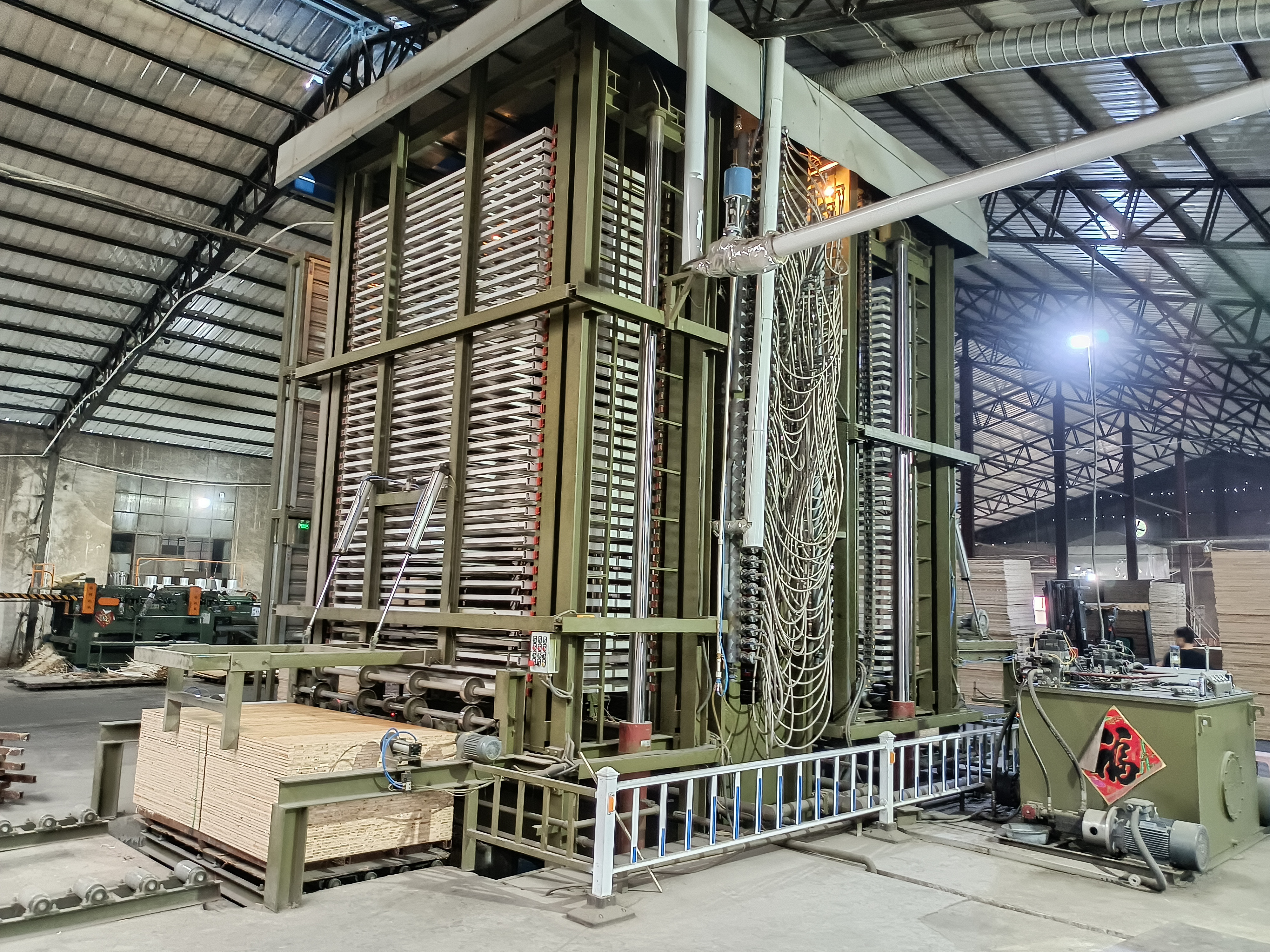
Pressing in a semi-automatic environment creates a natural production bottleneck. Operators rely on manual labor or lift tables to load and unload the press platens. Loading a 15-daylight press takes several minutes. This staggered loading process results in slower overall cycle times. The uneven loading speeds mean that the first panels placed in the hot press begin curing before the press fully closes, leading to pre-cure issues and weakened glue bonds.
Implementing an automatic plywood hot press machine resolves these inefficiencies completely. These advanced presses are equipped with automated loading cages, synchronized unloaders, and simultaneous closing mechanisms. Every panel enters the press simultaneously. Hydraulic systems utilize proportional valves to control the closing speed and pressure curve precisely, preventing core shifting during the initial compression phase and ensuring uniform heat distribution.
The finishing department in a semi-automatic mill is highly subjective and labor-intensive. Manual putty application with trowels, visual defect inspection, manual edge sawing, and manual grading create a severe bottleneck at the end of the line. Workers physically flip heavy panels to inspect both faces, leading to fatigue and inconsistent quality control standards.
Fully automated finishing transforms this chaotic environment. Implementation of a semi automatic plywood putty line or fully automated scanning and patching systems standardizes surface quality. Panels flow seamlessly through inline wide-belt sanding machines configured with specific grit sequences for calibration and finishing. Automatic edge trimmers size the panels to exact tolerances, and CNC-controlled automatic stackers streamline final packaging.
The initial investment required for fully automatic lines represents a massive upfront capital injection. This expenditure goes beyond purchasing the machinery itself. Facilities require extensive structural modifications, reinforced foundations for heavy press hydraulics, advanced safety enclosures, and upgraded electrical infrastructure to support continuous automated operations.
The operational savings generated by automation aggressively offset these initial costs over time. Calculating the payback period involves analyzing reduced headcount, lower worker compensation claims, and drastically decreased material waste. Automated lines apply glue with microscopic precision and maximize veneer yield, resulting in a significantly higher percentage of premium, A-grade panels.
Energy consumption profiles differ significantly. Fully automated continuous lines have higher baseline power requirements due to the constant operation of conveyors and sensors. They typically achieve lower per-unit energy costs compared to batch-processed semi-automatic lines, which suffer from the massive amperage spikes associated with constantly starting and stopping heavy motors.
Semi-automatic lines hold a distinct advantage regarding changeover times. They adapt much faster to custom orders, varying panel thicknesses, and non-standard dimensions. Because human operators control the material flow, they adjust machinery settings on the fly, making semi-automatic setups highly responsive to fluctuating market demands and specialized client requests.
Fully automatic lines excel in rigid, standardized production environments. They deliver unmatched throughput consistency when running identical panel specifications for days or weeks at a time. Changing panel dimensions on a fully automated line requires extensive reprogramming, mechanical adjustments to sensors, and recalibration of handling equipment, causing costly production downtime.
Evaluation Parameter | Semi-Automatic Line | Fully Automatic Line |
|---|---|---|
Initial Investment (CAPEX) | Moderate; utilizes standard machinery and existing facility layouts. | High; requires advanced CNC equipment, sensors, and structural modifications. |
Labor Dependency | High; relies on manual material handling and machine operation. | Low; requires a small team of specialized technicians for monitoring. |
Production Flexibility | Excellent; rapid changeovers for custom sizes and mixed batches. | Limited; best suited for long runs of standardized commodity panels. |
Maintenance Skill Level | Basic mechanical and electrical troubleshooting. | Advanced PLC programming, pneumatics, and sensor calibration. |
Throughput & Yield | Variable; highly dependent on operator fatigue and manual precision. | Maximum consistency; minimizes material waste and ensures uniform quality. |
The most significant physical risk of automation involves infrastructure and space requirements. Fully automatic lines demand linear, uninterrupted footprints to accommodate continuous conveyors and inline processing equipment. Retrofitting an older, compartmentalized mill for full automation requires expensive structural modifications, including removing load-bearing walls, extending the factory floor, or excavating deep pits for press hydraulic cylinders.
Operators must conduct a comprehensive 3D spatial analysis before purchasing any equipment. Engaging with machinery engineers to map the exact material flow prevents costly installation delays. If linear space is unavailable, implement U-shaped automated layouts or right-angle transfer stations that condense the machinery footprint while maintaining continuous automated flow.
Fully automated lines consume massive amounts of compressed air to actuate cylinders, diverters, and clipping knives. A standard semi-automatic mill operates on a single 50HP rotary screw compressor. Upgrading to full automation requires installing multiple 100HP compressors with dedicated air dryers and receiver tanks to maintain a constant 90 PSI across the entire line. Pressure drops cause pneumatic cylinders to actuate slowly, throwing off the timing of high-speed conveyors and causing catastrophic material jams.
The facility must support a significantly higher motor load. Automated lines utilize dozens of VFDs and servo motors to control conveyor speeds precisely. This requires upgrading the main electrical service, installing new motor control centers, and running shielded cables to prevent electromagnetic interference from disrupting sensitive PLC communication networks.
Transitioning from a semi-automatic to a fully automatic facility introduces severe workforce challenges. The shift from unskilled manual labor to skilled technicians requires extensive training. A breakdown in a fully automated line halts the entire factory, as the continuous flow is interrupted. A semi-automatic line bypasses a broken station manually, keeping production moving.
The most effective mitigation strategy is to execute a phased plywood production line upgrade. Automate the most severe bottleneck first to build internal technical capacity gradually. Upgrading a single department allows your maintenance team to develop the necessary electro-mechanical troubleshooting protocols before committing to a full facility overhaul.
Establish a daily sensor cleaning schedule to prevent optical faults on conveyor transfer decks.
Implement a vibration analysis program for all main drive motors and chipper bearings.
Calibrate inline moisture detectors weekly using oven-dry testing methods to ensure sorting accuracy.
Rebuild pneumatic cylinders proactively based on cycle counts rather than waiting for seal failure.
Backup all PLC logic and HMI configurations to a secure, off-site server monthly.
Conduct a time-study on current production bottlenecks to identify the specific stations causing the most severe delays.
Request layout schematics and utility requirements from equipment vendors to verify your facility can support the electrical and pneumatic demands.
Calculate operational costs over a 5-10 year horizon, factoring in maintenance, energy consumption, and training expenses.
Execute a phased upgrade strategy, starting with the integration of automated layup or pressing systems, to build internal technical capacity gradually.
A: A complete line includes log debarking machinery, veneer peeling lathes, continuous dryers, glue spreading equipment, veneer layup systems, cold and hot presses, wide-belt sanders, edge trimming saws, and automatic stacking machines.
A: The operational payback period typically ranges from two to five years. This timeframe depends heavily on local labor rates, the resulting increases in production volume, and the significant reduction in material waste such as adhesive and damaged veneer.
A: Yes, upgrading the press department is a highly effective phased approach. It requires adding automated loading and unloading cages that can seamlessly interface with your existing manual forklift delivery systems.
A: It utilizes optical sensors and precise mechanical alignment to eliminate core gaps and overlapping veneers. This ensures uniform structural integrity throughout the panel, prevents internal voids, and significantly reduces the risk of delamination.
A: Maintenance requires regular cleaning of optical sensors, daily checks of pneumatic cylinders, and periodic PLC software updates. This necessitates a transition from basic mechanical repairs to advanced electro-mechanical troubleshooting.
A: Yes. For hardwood and appearance-grade panels, it standardizes the surface repair process, drastically reduces putty waste, and speeds up the finishing bottleneck when compared to traditional manual troweling methods.
A: Unplanned downtime is the greatest risk. Because the line operates continuously, a single sensor failure or mechanical jam at one station halts the entire production process until the issue is resolved by maintenance personnel.
