
Hand phone / Whatsapp
+86-155-8805-8177
Views: 0 Author: Site Editor Publish Time: 2026-10-14 Origin: Site


Manual veneer grading remains a critical bottleneck in high-volume plywood manufacturing, where human fatigue and subjective judgment lead to inconsistent sheet sorting. Mill operators rely on visual inspections to categorize wood sheets, but high line speeds make accurate manual assessment nearly impossible. Misclassifying veneer grades results in "grade giveaway"—selling high-quality wood at lower prices—or structural failures in finished panels. Both outcomes directly impact mill profitability and compliance with stringent structural standards. Transitioning from manual inspection to an AI veneer grading machine transforms subjective visual assessment into a quantifiable, high-speed, and repeatable process. This guide breaks down how to evaluate these systems based on defect detection capabilities, integration requirements, and vendor reliability.
Defect Precision: AI systems standardize the detection of complex defects—such as distinguishing between sound and unsound knots, measuring crack propagation, and assessing color uniformity—reducing grade giveaway by up to 15%.
System Integration: A successful automatic veneer grading line must seamlessly communicate with downstream machinery, particularly veneer patching equipment, to optimize material recovery.
Evaluation Criteria: Selecting a system requires looking beyond baseline camera resolution to evaluate the machine learning model's adaptability to specific wood species and mill conditions.
Risk Mitigation: Environmental factors like mill dust, ambient lighting, and vibration are the primary causes of system failure; robust hardware enclosures and vendor-provided calibration protocols are non-negotiable.
Establishing the baseline cost of manual grading errors is the first step in upgrading your facility. You must calculate current labor costs, downgrade percentages, and customer rejection rates. Manual graders typically process sheets at high speeds, leaving fractions of a second to make complex quality decisions. Fatigue naturally sets in during a shift. Graders often default to downgrading acceptable sheets to avoid the risk of passing defective material. This conservative approach artificially deflates your high-grade yield.
Accurate defect classification directly correlates with material recovery. When you correctly identify the exact size and nature of an anomaly, you can route the sheet to the appropriate downstream process. Over-grading leads to panel delamination and structural failure. Under-grading destroys your profit margins. Understanding how specific defects behave during the layup process highlights the necessity for precise visual sorting.
Grading Metric | Manual Visual Inspection | Automated AI Scanning |
|---|---|---|
Processing Speed | Limited by human reaction time (approx. 100-150 fpm) | Continuous high-speed scanning (up to 400+ fpm) |
Defect Accuracy | Subjective, drops significantly after 2 hours of shift | Objective, maintains 99% consistency 24/7 |
Data Logging | None or manual tally sheets | Real-time SQL database tracking per sheet |
Grade Giveaway | High (operators default to conservative downgrading) | Low (optimized to exact structural tolerances) |
Distinguishing between tight, sound knots and loose, unsound knots challenges even experienced manual graders. Sound knots remain firmly integrated into the surrounding wood grain. They do not compromise the structural integrity of the finished plywood panel. Higher grade standards often permit sound knots up to a specific diameter. Unsound knots lack this structural integration. They frequently fall out during the drying process or the hot press cycle, leaving voids in the veneer.
Automated systems use depth and density mapping to classify knot types instantly. Optical sensors detect the visual outline of the knot, while laser profiling determines if the knot surface is flush with the surrounding wood. If the knot shows signs of separation or decay, the system flags it as unsound. The software then calculates the total knot area per sheet. If the combined area exceeds the allowable threshold for a face grade, the system automatically routes the sheet to a lower-grade sorting bin or designates it for patching.
End-splits and surface cracks develop primarily during the drying process. As moisture leaves the wood, the veneer shrinks. Uneven shrinkage causes the wood fibers to tear. Rough handling during the peeling and clipping stages also introduces mechanical splits. If these cracks exceed permissible lengths, they create weak points in the final plywood panel. Resin can bleed through these cracks during pressing, ruining the aesthetic finish of face-grade panels.
Automated scanners measure split length and width with sub-millimeter precision. The software evaluates the trajectory of the crack. It determines if a sheet can be salvaged via clipping or if it must be routed entirely to core stock. For example, a long, narrow split might be acceptable for inner plies but unacceptable for a face veneer. The system instantly applies the specific grading rules of your target product, ensuring no cracked sheets compromise the structural rating of the final panel.
Color variations play a massive role in face-grade veneer sorting. Customers demand visual uniformity for architectural and furniture-grade plywood. Sapwood and heartwood exhibit distinct color differences. Fungal staining, such as blue stain, drastically alters the appearance of the wood without necessarily degrading its structural strength. Manual graders struggle to maintain consistent color sorting under varying ambient mill lighting.
Beyond aesthetics, color markers often correlate with localized moisture pockets. Wet spots in the veneer cause severe problems during plywood assembly. When the panel enters the hot press, trapped moisture turns to steam. This steam expands and blows the panel apart, causing catastrophic delamination. Advanced optical systems detect specific color variations linked to high moisture content. By identifying these visual markers, the system prevents wet sheets from reaching the glue line, ensuring consistent adhesion.
Handling damage frequently causes edge chips and wane. Forklifts, conveyors, and rough transition points break off sections of the fragile veneer edges. If a sheet with severe edge damage enters the layup line, it creates voids along the perimeter of the finished panel. These voids require manual filling later, slowing down production. The optical scanner evaluates the entire perimeter of the sheet to ensure it meets minimum dimensional tolerances.
Internal voids or core gaps pose an even greater threat. If inner plies have missing sections, the final panel will lack uniform density. This leads to core failure when the end-user cuts or fastens the plywood. The grading system maps the exact location and size of every missing chunk of wood. It calculates whether the sheet retains enough surface area to function as a core layer. Sheets failing this dimensional check are instantly rejected or sent to a composer line for joining.
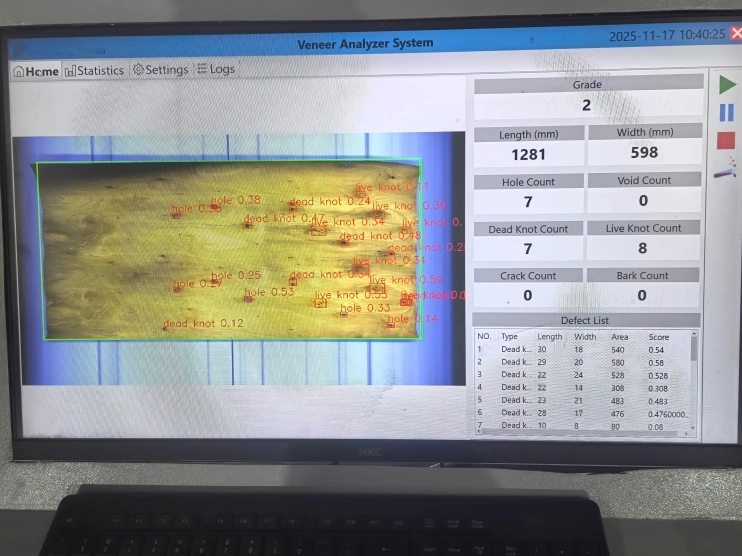
Upgrading your mill shifts operations from reactive quality control to proactive yield optimization. Traditional rule-based optical scanners rely on rigid geometric definitions. If a defect does not perfectly match the programmed shape or contrast ratio, the system misses it. Modern deep-learning architectures operate differently. They understand the context of the wood grain, adapting to natural variations just like a human brain, but with absolute consistency.
Understanding the data pipeline reveals why these systems outperform manual labor. The hardware captures the physical reality of the wood, while the software translates that reality into actionable sorting commands. This integration of optics, processing power, and mechanical actuation must happen in milliseconds.
The operational sequence requires perfect synchronization between cameras, computers, and conveyors. Here is how the system processes a single sheet of veneer:
High-Speed Infeed Scanning: Veneer sheets travel down the conveyor at speeds exceeding 300 feet per minute. The camera bridge captures a continuous, high-resolution image of the moving wood.
Real-Time Defect Mapping: The software analyzes the image, identifying every knot, split, and stain. It maps the exact X-Y coordinates of each anomaly.
Algorithmic Grade Assignment: The system calculates the total defect area and compares it against the active grading recipe to determine the highest possible yield category.
Position Tracking: Using encoder pulses from the drive motor, the PLC tracks the exact physical location of the sheet on the belt.
Automated Sorting Bin Actuation: When the sheet reaches the correct bin, pneumatic actuators open the sorting gate, dropping the veneer into the designated stack.
A reliable veneer visual inspection system relies on a robust hardware stack. High-resolution line-scan cameras form the core of the setup. Unlike standard area-scan cameras, line-scan cameras capture the image one pixel row at a time. This method eliminates motion blur, producing a perfectly crisp image of the fast-moving veneer. Multispectral imaging adds another layer of data, capturing light wavelengths invisible to the human eye to detect specific chemical or moisture variations.
Laser triangulation provides three-dimensional data. A laser line projects across the width of the conveyor. A camera positioned at an angle monitors this line. If the laser line dips or breaks, the system knows there is a physical hole, crack, or thickness variation. Combining 2D visual data with 3D topographical data prevents false positives. For example, the system will not mistake a dark surface shadow or a harmless resin streak for a physical crack, ensuring accurate grading.
Traditional rule-based vision systems fail when wood species change or natural variance increases. You cannot program a strict geometric rule for every possible shape a knot might take. Rule-based systems require constant tweaking by software engineers. If the log supply changes from winter to summer, the rigid rules generate massive amounts of false rejects. The system becomes a bottleneck rather than a solution.
Neural networks solve this inflexibility. These models are trained on thousands of annotated defect images. Quality control experts manually label images of knots, splits, and stains. The neural network analyzes this dataset, learning to recognize irregular patterns that defy strict geometric rules. It learns what a sound knot looks like across hundreds of variations. When presented with a new, unseen knot on the production line, the AI accurately classifies it based on learned contextual clues, adapting seamlessly to natural wood variance.
Feature | Traditional Rule-Based Vision | Deep Learning AI |
|---|---|---|
Defect Recognition | Relies on strict geometric shapes and contrast thresholds | Understands contextual wood grain patterns and irregular shapes |
Adaptability | Fails when natural wood variance changes | Adapts automatically based on training datasets |
Setup Time | Requires extensive coding for every new defect type | Requires feeding annotated images into the neural network |
False Reject Rate | High (often mistakes shadows for cracks) | Low (uses multi-sensor data to verify physical reality) |
Selecting the right hardware requires a strict evaluation framework. You must assess technical specifications against your actual operational outcomes. High camera resolution means nothing if the software cannot process the data fast enough to actuate the sorting gates. You need a system that balances processing power with mechanical reliability.
Effective plywood veneer quality control depends on how well the new technology integrates into your existing mill infrastructure. Standalone systems that do not communicate with downstream equipment limit your potential yield recovery. You must evaluate the data handoff capabilities, the software interface, and the mechanical thresholds of the sorting line.
The primary processing threshold is line speed. Can the AI compute defect data and actuate the sorting gates at line speeds exceeding 400 feet per minute without dropping accuracy? High-speed scanning requires immense computational power. If the image processing takes too long, the sheet will pass the sorting bin before the gate receives the open command. This latency results in mis-sorted sheets, defeating the purpose of the automated line.
Evaluate the latency in image processing. The system must capture the image, run the neural network inference, assign the grade, and send the signal to the PLC in under 100 milliseconds. Ask vendors to demonstrate their accuracy rates at your specific production speeds. A system that achieves 99% accuracy at 150 feet per minute might drop to 70% accuracy at 350 feet per minute due to motion blur and processing bottlenecks.
Grading is only the first step in material recovery. The data generated by the scanner must flow to downstream machinery. The primary integration point is with your veneer patching equipment. When the scanner identifies an unsound knot or a localized defect, it maps the precise X-Y coordinates of that anomaly. It then sends this spatial data directly to the automated patching station.
Evaluate the software compatibility between the grading line and your existing mill infrastructure. Look for open APIs and standard PLC communication protocols like Profinet or Ethernet/IP. The patcher must receive the coordinate data and align its cutting and routing heads perfectly with the physical defect on the sheet. Seamless data handoff eliminates the need for secondary scanning at the patching station, increasing overall line throughput and maximizing the volume of upgraded face veneer.
Mill operators need control over the grading parameters. The user interface must be intuitive. Quality control managers must be able to adjust grading rules—such as tightening knot size allowances or changing split length tolerances—without requiring a software engineer on site. If adjusting a parameter requires writing code, the system is too rigid for daily mill operations.
Review the system's ability to store and switch between different grading standards. Your mill might produce panels for the APA standard one week and the JAS or CE standard the next. The software should allow operators to select a pre-configured grading recipe from a drop-down menu. This instantly updates the defect thresholds and sorting bin assignments across the entire line, ensuring continuous compliance with varying international structural standards.
Deploying sensitive optical equipment in a harsh industrial environment presents significant physical and operational hurdles. An automatic veneer grading line is not a plug-and-play appliance. It requires careful site preparation, robust hardware protection, and a structured transition period for your workforce.
Ignoring the environmental realities of a plywood mill guarantees system failure. Dust, vibration, and fluctuating power supplies will destroy unprotected cameras and computers. Successful implementation requires treating the optical bridge as a highly sensitive zone within a brutal manufacturing environment.
Mill dust is the primary threat to lens clarity and sensor accuracy. Fine wood particulate coats camera lenses, reducing contrast and causing the software to miss defects. To combat this, the hardware requires positive-pressure camera enclosures. These enclosures pump clean, filtered air into the camera housing, forcing dust away from the lens. Automated lens cleaning mechanisms, such as timed air blasts, provide an additional layer of protection.
Ambient lighting and vibration also disrupt scanning accuracy. Sunlight streaming through a loading dock door can blind the sensors, creating false defect readings. The scanning zone must be heavily shielded from external light sources. Furthermore, the massive peeler lathes and heavy forklifts operating nearby generate severe floor vibrations. The camera bridge requires vibration-isolated mounting frames. If the cameras shake during scanning, the resulting image blur will crash the neural network's accuracy.
Transitioning to automated grading requires a structured validation period. You cannot simply turn the machine on and fire your manual graders. Run the AI system in parallel with your manual grading team for the first several weeks. Have the automated system assign grades, but allow human operators to verify the physical sorts. This parallel running validates the machine learning model against your specific wood supply and builds operator trust in the technology.
Ongoing calibration remains necessary. When you change wood species, the visual characteristics of the veneer shift entirely. The system needs to know it is looking at Birch instead of Radiata Pine. Operators must be trained to select the correct species profile in the software. Additionally, seasonal variations in log quality—such as frozen winter logs versus wet spring logs—require minor adjustments to the defect thresholds to maintain consistent yield.
You must establish strict Key Performance Indicators (KPIs) before installing the equipment. Document your current manual downgrade rates, your volume of grade giveaway, and your downstream patching bottlenecks. Once the automated line is operational, compare these baseline metrics to the AI-optimized recovery rates. The primary goal is to measure the exact percentage of high-grade veneer recovered that was previously downgraded by human error.
Track specific metrics during the first 90 days of operation. Monitor the reduction in grade giveaway, the increase in patching efficiency, and the decrease in panel delamination rates at the hot press. These data points validate the algorithmic accuracy of the system. A properly calibrated line typically demonstrates a measurable increase in high-grade yield within the first month, driving a rapid return on investment.
Hardware is only as reliable as the company standing behind it. When selecting a veneer grading machine manufacturer, prioritize long-term support over initial purchase price. Define strict criteria for vendor selection. Demand Service Level Agreement (SLA) guarantees for system uptime. The vendor must provide rapid remote diagnostics, allowing their engineers to log into your system securely to troubleshoot software issues without waiting for a site visit.
Emphasize the importance of choosing a partner with specific expertise in the plywood sector. General machine vision companies often fail in wood processing because they do not understand the biological variance of timber. Your vendor must understand the difference between a lathe check and a drying split. They must maintain a robust inventory of spare parts, including replacement cameras, lasers, and PLC modules, ensuring your line never sits idle waiting for overseas shipping.
To successfully transition your mill from manual sorting to an automated grading system, execute the following steps:
Audit your current grade giveaway percentages to establish a financial baseline for the upgrade.
Compile a sample batch of highly variable veneer sheets from your typical log supply.
Require shortlisted vendors to process this sample batch in a pilot test to prove their algorithmic accuracy.
Evaluate your existing patching equipment for API and PLC compatibility with modern spatial data handoffs.
Design a rigid parallel-testing protocol for your operators to validate the automated sorts during the first month of installation.
A: Implementing automated grading typically reduces grade giveaway significantly, resulting in a 5% to 15% improvement in high-grade veneer recovery. The exact yield increase depends on the baseline accuracy of your previous manual sorting operations and the natural variance of your log supply.
A: No, standard visual inspection systems only detect surface anomalies like knots, splits, and stains. Detecting internal defects, such as hidden core voids or deep moisture pockets, requires integrating the visual scanner with ultrasonic sensors or specialized moisture-sensing modules.
A: The return on investment is usually achieved within 12 to 24 months. This rapid ROI is driven by direct labor savings, a massive reduction in downgrade losses, optimized routing to patching stations, and fewer rejected panels after the hot press cycle.
A: The system utilizes precise coordinate mapping. When the optical scanner identifies a defect requiring a patch, it calculates the exact X-Y coordinates on the sheet. It sends this spatial data directly to the patcher's PLC, which automatically aligns the cutting heads to remove the defect.
A: Maintenance involves daily cleaning of the external lens shields, weekly calibration checks using standardized test patterns, and routine inspection of the positive-pressure air systems. Ensuring the air filters remain clean is critical to keeping mill dust out of the sensitive camera enclosures.
A: Operators calibrate the machine by selecting pre-trained species profiles directly from the software's user interface. If introducing a completely new species, you must feed the neural network a new dataset of annotated images so the AI can learn the specific visual characteristics of that wood.
