
Hand phone / Whatsapp
+86-155-8805-8177
Views: 0 Author: Site Editor Publish Time: 2026-11-09 Origin: Site


Setting up a wood processing facility requires heavy capital investment. Your equipment selection determines long-term profitability and daily operational viability. Procuring a complete production line means engineering a synchronized system, not just buying individual units. Mismatched equipment causes severe production bottlenecks, high energy waste, and poor veneer recovery rates. If your lathe outpaces your dryer, you end up with piles of wet veneer degrading on the factory floor. We provide a structured evaluation framework below. You will assess capacity requirements, compare automation levels, and vet suppliers. This ensures seamless integration from log cross-cutting to final sanding. Choosing the right plywood production machine setup forms the foundation of your plant's success. You need machines that talk to each other, share a logical workflow, and keep downtime to an absolute minimum.
Capacity Synchronization is Critical: The throughput of your veneer peeling and drying stages must perfectly align with your pressing capacity to prevent costly idle time.
Pressing Technology Dictates Quality: Selecting the right heating medium and hydraulic system for your plywood press machine directly impacts panel structural integrity and cycle times.
Automation Requires Infrastructure: Upgrading to automatic plywood machinery reduces labor costs and improves yield, but demands higher initial CapEx and specialized maintenance personnel.
Vendor Vetting Goes Beyond Price: A reliable plywood machine manufacturer must provide comprehensive installation, commissioning, and long-term spare parts availability, not just competitive upfront pricing.
Calculate your required daily output in cubic meters (CBM) before looking at equipment catalogs. This metric dictates the sizing of your entire line. If your goal is 50 CBM of finished plywood per eight-hour shift, work backward to determine raw material needs. Plywood manufacturing typically yields a 40% to 50% recovery rate from raw log to finished panel. You need a log processing capacity of at least 100 to 125 CBM per shift to hit that 50 CBM target. Every machine in the sequence must handle this volume. Sizing a lathe for 100 CBM while installing a dryer that only processes 60 CBM creates an immediate, unfixable bottleneck. You must also factor in maintenance downtime. A machine rated for 10 CBM per hour will not produce 80 CBM in an eight-hour shift. Tool changes, blade sharpening, and clearing jams eat into production time. Calculate your capacity based on a realistic 80% to 85% operational efficiency rate.
The physical characteristics of your wood supply directly influence machine specifications. Log diameter determines the swing capacity required for your peeling lathes. Large-diameter logs require heavy-duty spindle lathes to initiate the peel. Small-diameter plantation logs can go directly to spindle-less lathes. Wood species also matters. Hardwoods like eucalyptus or birch demand higher horsepower motors and reinforced cutting blades compared to softwoods like pine. Moisture content impacts your drying strategy. High-moisture species require longer dryer configurations with additional heating sections. You must reach the target 8% to 10% moisture content required for optimal gluing. If you run wet wood through the glue spreader, the panels will blow apart in the hot press due to trapped steam. Additionally, consider log conditioning. Hardwoods often require boiling or steaming vats to soften the wood fibers before peeling. This prevents the veneer from cracking and reduces wear on the lathe knives.
Your end-product dictates the necessity of specific machinery. Commercial interior plywood requires standard urea-formaldehyde gluing and basic pressing. Marine-grade plywood demands phenolic resins. These resins require higher pressing temperatures and longer cycle times. If you plan to produce film-faced plywood for concrete formwork, you need specialized pressing equipment. These upgraded panels require mirror-finish platens, precise temperature controls, and specific pressure profiles to cure the surface films without blistering. Melamine-faced boards require even stricter surface tolerances. Your sanding line must feature multi-head calibration and finishing sanders to prevent telegraphing defects through the thin melamine paper.
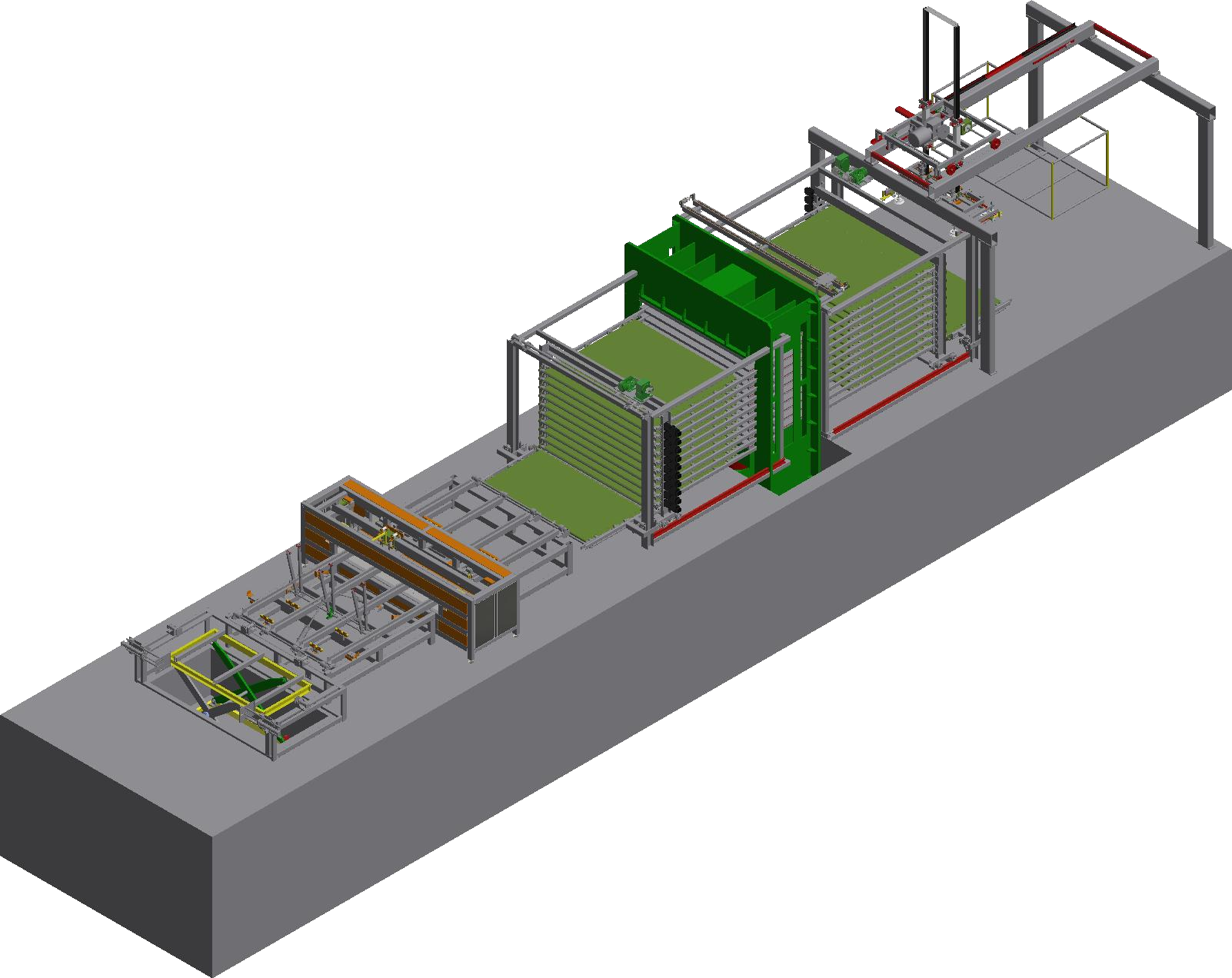
The peeling process determines your maximum potential yield. Efficient log preparation minimizes waste before the wood ever touches a lathe blade.
Log Saws and Cross-Cutting: Automated log cutting saws provide precise length control. Laser-guided systems scan the log and calculate the optimal cut points to maximize the number of usable blocks. This prevents short blocks that cause lathe chucking issues. Proper centering is also critical. If a block is chucked off-center, the lathe spends the first several rotations cutting useless fish-tails instead of a continuous veneer ribbon.
Debarkers: Bark contains dirt, rocks, and grit. Running unbarked logs through a peeling lathe destroys expensive cutting knives in minutes. Heavy-duty rounding debarkers remove the bark and create a uniform cylinder. This streamlines the peeling process and extends blade life.
Peeling Lathes and Clippers: Evaluate veneer thickness precision and cutting speed. Spindle lathes grip the ends of large logs, peeling them down to a core of about 100mm. Spindle-less lathes take that core and peel it down to 30mm or less, maximizing wood recovery. Modern lines integrate CNC rotary clippers directly behind the lathe. These clippers use optical sensors to detect defects and cut the continuous veneer ribbon into uniform sheets at high speeds.
Wet veneer cannot be glued. The drying stage ensures panel stability and bond strength.
Drying Technology: Choose between mesh belt dryers and roller dryers. Roller dryers are the industry standard for core veneers. They feed sheets between heated rollers, keeping the wood flat while driving out moisture. Mesh belt dryers support fragile face veneers on a continuous wire mesh, preventing tearing. Evaluate thermal efficiency, insulation thickness, and moisture content uniformity across the width of the dryer. Modern dryers utilize multiple temperature zones. The wet veneer enters a high-heat zone to rapidly flash off surface moisture, then moves into lower-heat zones to gently dry the core without causing the wood to buckle or split. A dedicated cooling section at the exit is also necessary to bring the veneer temperature down before stacking.
Veneer Composers: Peeling generates narrow wood strips and random-width pieces. Core veneer composers stitch or glue these narrow strips together into full 4x8 sheets. This utilizes material that would otherwise become waste. A good composer creates solid core layers without overlaps or gaps. This prevents core voids in the final panel.
Adhesive application requires precision. Too little glue causes delamination. Too much glue wastes money and causes steam blows during hot pressing.
Glue Spreaders: Evaluate roller configurations carefully. A 3-roller spreader works for basic applications. A 4-roller spreader utilizes doctor rolls against the applicator rolls to precisely meter the glue spread. This ensures uniform application across the entire veneer sheet and minimizes adhesive waste. You must monitor glue viscosity and pot life. In hot climates, glue can pre-cure in the spreader pan. Installing chiller units on your glue mixers extends the pot life and maintains a consistent spread rate.
Lay-up Systems: Manual lay-up tables require significant labor and rely on human accuracy. Automated assembly lines use vacuum feeders and alignment guides to stack the glued veneers perfectly square. This improves speed and reduces the amount of edge trimming required later.
The pressing department is the heart of the plywood manufacturing equipment line. It dictates the structural integrity of your product.
Pre-Pressing (Cold Press): Cold pressing is mandatory for high-volume production. The cold press applies hydraulic pressure to the un-cured panel stack at room temperature. This tacks the veneers together, expels trapped air, and flattens the stack. A well-tacked panel is easier to load into the hot press and reduces the risk of veneer shifting.
The Hot Press: Selecting a 4x8 plywood hot press machine requires strict evaluation of platen size, daylight openings, and hydraulic cylinder quality. Daylight openings refer to the number of gaps between platens. A 15-daylight press cures 15 panels simultaneously. Ensure the steel frame is thick enough to withstand continuous high-pressure cycles without deflecting. Pressure distribution must be perfectly even across the 4x8 surface to prevent weak spots. Standard commercial plywood typically requires pressing pressures around 10 to 14 kg/cm2, while high-density panels require much more. Pressing time is generally calculated at roughly one minute per millimeter of panel thickness, plus a base curing time. Your press hydraulics must deliver this pressure quickly and hold it steady without pressure drops.
Specialized Pressing Applications: Producing upgraded panels requires specific press configurations. A melamine hot press machine or a film face hot press machine operates at higher temperatures and requires distinct pressure profiles. These machines often feature stainless steel platens with specific surface finishes to imprint textures or high-gloss finishes onto the panels.
Heating Mediums: Choose how to heat your press platens. This choice impacts energy consumption and temperature consistency.
Heating Medium | Temperature Consistency | System Pressure | Best Application |
|---|---|---|---|
Steam Boiler | Good, but can fluctuate | High pressure required | Standard commercial plywood |
Thermal Oil Heater | Excellent, highly uniform | Low operating pressure | Film-faced and melamine panels |
Connecting individual machines is just as important as the machines themselves. Automated conveyors, scissor lifts, and vacuum feeders maintain a continuous flow across the line. Scissor lifts keep the veneer stacks at an ergonomic working height for operators, reducing fatigue. Powered roller conveyors move heavy panel stacks between the cold press, hot press, and sizing saws without forklift intervention. Robust material handling prevents damage to the panels and keeps the machines fed.
The final stages determine the visual quality and dimensional accuracy of your product.
Trimming Saws: Double sizing saws trim the raw pressed panels down to the exact 4x8 dimensions. Evaluate edge trimming precision and the automation of the feeding mechanism. Integrated dust extraction is critical here to prevent sawdust buildup from fouling the tracks.
Sanding Machines: Wide belt sanders smooth the panel surfaces. You need a combination of calibration heads (using coarse 60 or 80 grit to achieve the correct thickness) and finishing heads (using fine 120 or 180 grit for a smooth surface). The sanding machine must hold strict surface tolerances, especially if the panels will be overlaid later. A heavy cast-iron machine frame is necessary to absorb vibration and prevent chatter marks on the finished plywood.
Choosing between manual systems and automatic plywood machinery involves analyzing initial investment against long-term operational expenses. Fully automated lines require a significantly higher capital expenditure upfront. However, they drastically reduce reliance on manual labor. In regions with high labor costs or high turnover rates, automation pays for itself quickly. Semi-automated lines are cheaper to install but incur higher daily operating costs due to the workforce required for material handling, lay-up, and machine feeding.
Automated sensors and PLC controls improve veneer recovery and reduce human error. An automated rotary clipper uses optical scanners to cut out defects with millimeter precision. This saves usable wood that a manual operator might discard. Automated lay-up lines ensure every panel is perfectly square, reducing the amount of edge waste generated at the trimming saw. Consistent machine-driven pacing also ensures that glue does not pre-cure before the panels reach the plywood press machine.
Highly automated systems require a different class of infrastructure. You need skilled technicians capable of troubleshooting PLCs, servo motors, and hydraulic proportional valves. A semi-automated line can often be repaired by a general mechanic with a wrench and a welder. An automated line requires electrical engineers and strict preventative maintenance schedules. You also need a highly reliable power grid. Voltage drops can scramble PLC logic and halt production.
The veneer dryer is the most common choke point in any plywood plant. Peeling lathes operate incredibly fast, generating massive volumes of wet veneer. Dryers operate slowly, as moisture removal takes time. If you under-size your dryer, your lathes will sit idle waiting for drying capacity to free up. Calculate buffer zones between peeling and drying. Many plants utilize wet veneer storage areas to hold inventory. This allows the dryers to run 24/7 while the lathes run single or double shifts.
Plywood production is energy-intensive. Under-sizing your boilers or thermal fluid heaters leads to disaster. If the heating system cannot maintain temperature when a cold load of panels enters the hot press, the platen temperature drops. This leads to extended press cycle times and poor bonding. Calculate the peak thermal load of your presses and dryers, and size your heating equipment accordingly.
Build a 15% to 20% capacity buffer into your critical machines. If your target is 100 CBM, install a dryer capable of 120 CBM. Ensure modularity for future upgrades. Buy a dryer with space to add extra heating sections later. Install a hot press frame that can accommodate additional daylight openings if you need to increase throughput. This forward-planning prevents you from having to replace entire machines when expanding.
Do not buy from a broker claiming to be a manufacturer. Evaluate the engineering capabilities and in-house machining quality of the actual factory. A reliable plywood machine manufacturer owns heavy-duty CNC boring and milling machines to process the massive steel frames of hot presses and lathes. Ask for their track record with complete line installations. Request reference contacts from plants operating their equipment in similar climates with similar wood species.
A vague quote is a red flag. A comprehensive plywood machinery quotation must include line-item breakdowns. It should specify the brand names for critical components like PLCs, hydraulic valves, and electric motors. It must detail the steel thickness used in press frames and dryer walls. The quote should clearly outline shipping terms and detail the scope of installation supervision provided by their engineers.
Machinery breaks down. Your profitability depends on how fast you can get it running again. Emphasize warranty terms and guaranteed response times for troubleshooting. Ensure that the standard wear parts used in the machines are globally available off-the-shelf components. If a manufacturer uses proprietary, custom-sized hydraulic seals, you will be entirely dependent on them for expensive replacements. This leads to extended downtime during shipping.
Finalize your daily output targets and target wood species to establish baseline capacity requirements for your peeling and drying stations.
Determine your final product mix to dictate your pressing and sanding specifications, ensuring you select the correct heating medium.
Initiate site layout planning to guarantee adequate floor space for machinery footprints and in-process material buffers.
Submit detailed Request for Quotations (RFQs) to at least three vetted manufacturers, demanding component brand transparency and installation terms.
A: The hot press and the peeling lathe are the primary drivers of quality and yield. The lathe determines how much usable veneer you extract from a log, directly impacting material costs. The hot press dictates the structural integrity, bond strength, and surface quality of the final panel.
A: Costs vary wildly based on capacity, automation levels, and origin of manufacture. A basic semi-automated line requires a moderate investment, while a fully automated, high-capacity line requires a massive capital outlay. Custom quotes based on specific cubic meter targets are always necessary to get accurate figures.
A: Complete lines require heavy industrial three-phase power. The total draw is massive. Components like multi-deck veneer dryers, heavy-duty spindle lathes, and the hydraulic pumps for large hot presses require dedicated high-voltage transformers and robust electrical infrastructure to prevent voltage drops.
A: Steam provides rapid heating but requires high-pressure boilers and can suffer from temperature fluctuations. Thermal oil operates at lower pressures and provides highly consistent, uniform temperatures across the platens. Thermal oil is generally preferred for high-end products like film-faced or melamine plywood.
A: Look for extreme detail. Demand line-item breakdowns, specific brand names for motors and PLCs, steel thickness specifications, and clear warranty terms. Ensure the quote explicitly covers installation supervision, commissioning, and operator training at your facility.
A: You must ensure capacity matching during the design phase. Size your dryer to handle 15% to 20% more throughput than your lathes produce. Utilize wet veneer storage buffers to hold excess peeled veneer, allowing the dryers to run continuously across multiple shifts.
