
Hand phone / Whatsapp
+86-155-8805-8177
Views: 0 Author: Site Editor Publish Time: 2026-11-09 Origin: Site


Plywood and veneer manufacturing operations face tightening profit margins across the board. Escalating raw timber costs and declining log quality squeeze mill operations daily. Relying on manual defect identification creates severe production bottlenecks. Spotting knots, splits, and moisture checking by hand leads to subjective grading inconsistencies. It causes excessive usable material waste on the clipping line. This wasted wood directly impacts your recovery rate. Missed defects weaken the structural performance of pressed plywood, leading to downstream panel rejection. Modern mills must standardize quality and recover every possible square inch of usable wood. Upgrading to automated veneer grading and patching replaces human guesswork with precision machine vision and robotic execution. This technology protects bottom-line profitability by ensuring only defective areas are removed. It allows mills to process lower-grade logs while maintaining high-value output. Implementing these systems transforms a chaotic grading process into a controlled manufacturing line.
Yield Optimization: Automated systems map defects with sub-millimeter accuracy, ensuring only the exact defect area is removed and patched, directly reducing raw material waste.
Throughput Scalability: A fully automated patching line can process up to double the capacity of manual patching stations while maintaining continuous operational uptime.
Data-Driven Grading: Integrating machine vision eliminates subjective human error, ensuring consistent grading that meets strict structural and aesthetic plywood standards.
Strategic Investment: While initial CapEx is significant, ROI is typically achieved through recovered veneer volume, reduced labor costs, and higher-tier grading classifications.
Mill success relies on three baseline metrics: veneer recovery rate, grade distribution, and throughput speed. The recovery rate measures how much usable veneer you extract from a raw log after it leaves the peeling lathe. Grade distribution tracks the quality classification of the final sheets, determining whether they can be sold as premium face veneer or relegated to structural core layers. Throughput speed dictates daily production volume. When defects like open knots, severe wane, or deep lathe checks compromise a sheet, these metrics plummet. Manual intervention slows the dry chain down. It forces operators to make split-second decisions that heavily impact the final yield. Optimizing these three metrics requires removing the variability inherent in human inspection.
A drop of just one percent in overall veneer recovery translates to thousands of board feet of lost material per shift. When operators manually grade sheets, they naturally err on the side of caution to avoid sending defective wood to the hot press. This caution results in perfectly good wood being sent to the chipper. You are essentially paying premium log rates for material that ends up as low-value biomass fuel. To maximize yield, mills must extract every possible square inch of clear wood from the ribbon.
High-speed peeling lines move veneer ribbons at incredible velocities, often exceeding 300 feet per minute. Human operators face severe physical limitations when trying to spot surface defects under these conditions. Identifying thickness variations, subtle wane, and fine moisture checking requires intense focus under harsh factory lighting. Operator fatigue sets in quickly. A tired worker will inevitably miss a tight knot or a hairline split.
When these defects pass through the line unnoticed, they cause massive problems later in the production cycle. A missed knot leads to uneven pressure distribution during the hot platen pressing stage. This creates steam blisters or weak bonds in the final plywood panel. Manual graders also struggle to accurately assess moisture content visually. Wet pockets in the veneer turn into steam during pressing, causing the panel to literally blow apart when the press opens. Relying on human eyes to catch these invisible flaws is a guaranteed way to increase your reject rate.
Manual clipping and patching generate massive amounts of material waste. Operators often over-cut to ensure they remove the entire defect. They chop out perfectly good wood alongside the knot or split. This over-cutting reduces the size of the usable sheet, forcing the mill to downgrade the veneer.
Operators manually punch out a 2-inch knot using a 4-inch die, wasting clear wood around the defect.
Fatigued workers clip too early on the green line, sending usable ribbon to the waste conveyor.
Manual patchers misalign the grain when inserting a patch, causing the sheet to be downgraded from face to core quality.
Under-patching leaves critical flaws intact, resulting in panel delamination downstream.
The hot platen press exposes every weakness in the veneer. Wasting good wood at the clipper directly destroys your profit margin. You need a system that cuts exactly what is required and nothing more.
Modern inspection relies on robust hardware mounted directly above the high-speed conveyor. Line-scan cameras capture high-resolution images of the veneer surface as it flies past. These cameras operate at thousands of frames per second, building a continuous digital map of the wood grain. Laser triangulation sensors measure topographical variations, detecting thickness issues, surface roughness, and deep lathe checks. Moisture sensors utilize near-infrared or radio frequency technology to scan the wood for critical moisture checking and hidden wet pockets.
This combination of optical and topographical scanning builds a complete digital profile of every single sheet. The hardware detects open knots, tight knots, splits, wane, and resin pockets with sub-millimeter precision. It sees flaws that are invisible to the naked eye. The scanner frame is typically mounted on heavy-duty vibration isolators to prevent the violent shaking of the peeling lathe from distorting the optical image.
The hardware feeds raw data directly into an AI veneer grading line. This software utilizes Convolutional Neural Networks to classify defects in real-time. The AI analyzes pixel clusters to differentiate between a harmless mineral streak and a structural split. It calculates the exact perimeter of a knot and determines whether it is tight enough to remain in a core sheet or loose enough to require patching.
Advanced machine learning techniques make these systems highly adaptable. Transfer learning allows the system to quickly adapt to new wood species without requiring massive new training datasets. If you switch from peeling Douglas Fir to Radiata Pine, the AI adjusts its grading parameters rapidly. It learns the specific grain patterns, color variations, and knot characteristics of the new species. The software communicates directly with the programmable logic controllers on the clipping and patching machines, sending exact coordinates for every cut.
Running a high-speed line requires balancing throughput with detection accuracy. Modern processing speeds demand continuous calibration of the automated veneer defect inspection system. If the sensors are too sensitive, they generate false positives. The system flags good wood as defective, leading to unnecessary patching and wasted material. If the sensors are not sensitive enough, they generate false negatives. The system misses critical structural flaws, leading to downstream panel failure.
Defect Type | Manual Detection Rate | Automated Detection Rate | Primary Sensor Used |
|---|---|---|---|
Open Knots | 85% | 99% | High-Speed Optical Camera |
Hairline Splits | 40% | 95% | Laser Triangulation |
Hidden Wet Pockets | 10% | 98% | Near-Infrared Moisture Sensor |
Thickness Variation | 30% | 99% | Laser Displacement Sensor |
Continuous software calibration ensures the system maintains peak accuracy while operating at maximum line speed. Mill technicians must regularly verify the scanner's output against physical samples to keep the delicate balance between recovering wood and maintaining structural integrity.
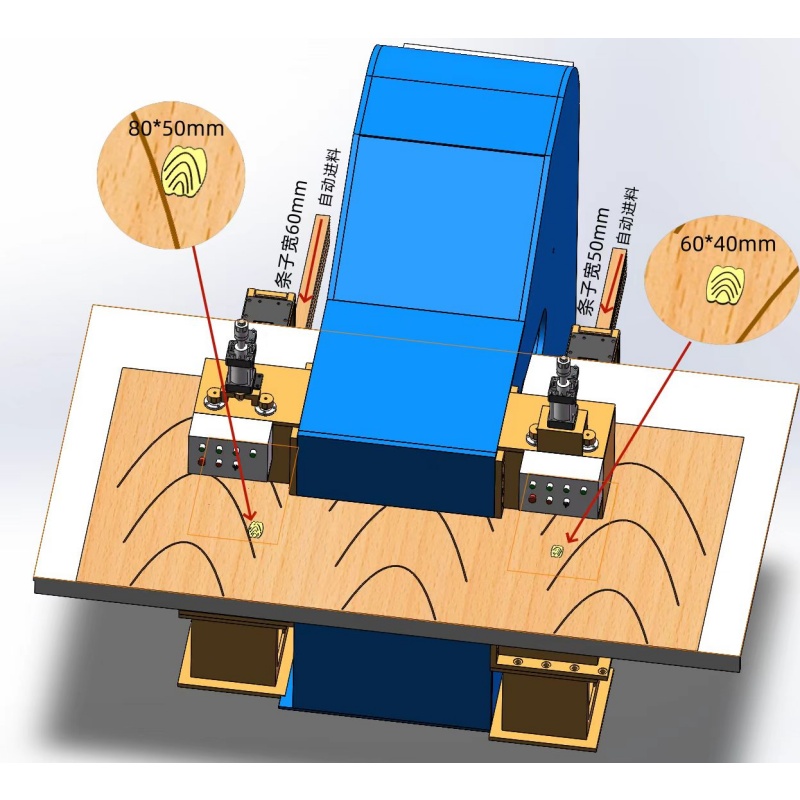
Automated systems map the entire veneer sheet digitally before any physical cut occurs. The software calculates the optimal clipping and patching strategy for each individual board. It analyzes the size, shape, and location of every defect. It then determines the exact coordinates for the patching die. This precision mapping eliminates the guesswork of manual clipping. The system knows exactly where to cut to remove the flaw while preserving the maximum amount of clear wood.
The software also accounts for the specific grade requirements of the current production run. If the mill is producing structural sheathing, the system might leave tight knots intact while patching open voids. If the mill is running face veneer for furniture, the system will patch every visible blemish. This dynamic decision-making ensures that the mill recovers every possible square inch of high-grade veneer based on the exact specifications of the final product.
Manual patching relies on a one-size-fits-all punch. Operators use the same die for a tiny pin knot and a massive open defect. Automated systems utilize dynamic patch sizing. They select the exact patch size needed for the specific flaw. This targeted approach preserves the structural integrity of the surrounding wood.
Dogbone patches are selected for narrow, elongated splits to prevent the crack from propagating further down the sheet.
Butterfly patches are utilized for larger, irregular knots to lock the surrounding grain together.
Boat patches are deployed for standard round defects, providing a clean, aesthetically pleasing surface.
When the automated die punches the defect, it simultaneously inserts a perfectly matched patch. The patch fits tightly, utilizing friction or adhesive tape to lock into place. This ensures the veneer performs optimally when stacked, glued, and pressed into plywood. The tight tolerances prevent glue bleed-through during pressing, which ruins the face of the panel.
Timber quality is declining globally. Mills are forced to process smaller, lower-grade logs filled with knots, sweep, and splits. Automated systems allow mills to purchase this cheaper timber and systematically upgrade the resulting veneer. The precision defect removal and patching process transforms low-grade sheets into structurally sound core or face layers.
The system recovers usable wood that manual operators would simply send to the chipper. By mapping the defects and applying targeted patches, a sheet that would normally grade out as a utility core can be upgraded to a standard face veneer. This capability allows mills to maintain high-value plywood output despite utilizing inferior raw materials. It completely changes the economics of log procurement, allowing buyers to source cheaper timber blocks without sacrificing the quality of the finished panels.
Selecting the right equipment depends heavily on your specific mill requirements and the types of veneer you process. Equipment categories break down into dedicated machines for different grain orientations and automation levels. You must match the machine's mechanical capabilities to your production volume and product mix. A mill producing high-end birch furniture plywood requires different patching tolerances than a mill producing southern yellow pine structural sheathing. Understanding these mechanical differences is critical for maximizing your equipment investment.
The physical footprint of the machinery also dictates your options. Some mills have massive open floor plans that can accommodate fully automated robotic lines with extensive safety fencing. Older mills often require compact, semi-automated machines that fit into existing production lines without requiring a complete factory redesign.
Core layers require specific handling. A cross grain veneer patching machine is engineered to handle the unique structural demands of these inner sheets. The feeding mechanisms and die orientations are designed specifically for short-grain material. Cross-grain sheets are notoriously fragile and prone to tearing when handled roughly.
Patching cross-grain core veneers prevents voids in the final plywood panel. Voids in the core lead to weak spots and potential delamination under load. When a carpenter drives a nail into a plywood sheet, a core void will cause the fastener to fail. The automated patcher ensures the core remains solid, providing a stable foundation for the face and back veneers. The machine uses specialized vacuum belts to hold the fragile short-grain sheets flat during the high-impact punching process.
Face and back veneers demand aesthetic perfection and tight tolerances. A long grain veneer patching machine handles these requirements. Aesthetic matching is critical for visible layers. The machine must align the grain of the patch with the grain of the surrounding wood. It requires high-precision dies that leave virtually invisible seams.
Long grain sheets are also more prone to splitting along the grain lines during the punching process. The automated system controls the punching force perfectly, preventing collateral damage to the high-value face veneer. The dies must be kept razor-sharp to ensure a clean cut through the dense latewood bands. Any tearing or crushing of the wood fibers around the patch will telegraph through the final finish, ruining the panel's visual appeal.
Mills must choose between installing fully automated robotic arms or upgrading existing equipment. A turnkey veneer patching machine offers massive throughput gains and requires minimal labor. However, it demands a significant initial capital expenditure and a large factory footprint. Alternatively, semi-automated retrofit kits upgrade standard manual patching machines. They add digital scanning and automated die control to existing frames. Retrofits offer lower initial overhead but cannot match the raw speed of a fully robotic line.
Feature | Turnkey Robotic System | Semi-Automated Retrofit |
|---|---|---|
Throughput Capacity | Extremely high; continuous operation | Moderate; limited by existing mechanics |
Installation Time | Extensive; requires line redesign | Fast; minimal line disruption |
Maintenance Complexity | Requires specialized robotics technicians | Manageable by standard mill mechanics |
Factory Footprint | Large; requires safety enclosures | Small; utilizes existing machine space |
Retrofitting automated grading scanners and patchers into legacy lines presents serious engineering challenges. Peeling lathes, continuous dryers, and manual clippers operate on older control systems. Integrating modern machine vision requires seamless communication between new software and old hardware. The conveyors must feed the veneer into the scanner at a precise, consistent speed. Any vibration or belt slippage distorts the optical image, ruining the defect mapping.
Mill engineers must stabilize the physical line before installing the digital sensors. This often involves replacing worn conveyor belts, upgrading drive motors to precision servos, and installing high-resolution encoders to track the exact position of the veneer ribbon. If the physical handling of the wood is sloppy, the most advanced AI scanner in the world will still produce inaccurate cuts.
Plywood mills are brutal environments for delicate electronics. High-dust environments wreak havoc on optical lenses and laser sensors. Wood dust coats the camera glass, blinding the AI grading system. Pitch and resin build up on the mechanical components. Specialized maintenance routines are mandatory.
Technicians must clean the optics daily using specialized solvents that do not degrade the lens coatings.
Positive pressure enclosures and air knives must be maintained to keep dust away from the sensor arrays.
Precision cutting dies require frequent sharpening to prevent tearing the veneer.
Robotic actuators and servo motors need regular lubrication to survive the continuous, high-speed repetitive motion.
Neglecting maintenance immediately degrades patching accuracy and increases material waste. A dull die will crush the wood fibers instead of cutting them, leading to loose patches that fall out during the drying process.
Installing automated systems forces a massive skill shift on the factory floor. The workforce transitions from manual laborers to machine operators and technicians. Workers who previously punched knots by hand must now manage complex grading software interfaces. They need to understand how to adjust sensitivity thresholds and interpret diagnostic data.
This transition requires a steep learning curve. Mill management must invest heavily in operator training programs. Failing to train the staff results in millions of dollars of equipment sitting idle due to simple software errors. Operators must learn to read the machine's fault codes, clear physical jams safely, and recalibrate the vision system when switching between different wood species or thicknesses.
Choosing the right partner dictates the success of your automation project. You must establish strict criteria for shortlisting manufacturers. Evaluate a veneer processing equipment supplier based on their integration experience and track record with your specific wood species. Look at their history of retrofitting legacy mills versus building greenfield sites. Ask for case studies detailing actual recovery percentage improvements.
A reliable vendor will provide transparent data on throughput speeds and machine uptime. They should be willing to run a sample batch of your specific logs through their test facility to prove their machine vision capabilities. Do not accept generic performance claims; demand data based on the exact thickness and moisture content of the veneer you process daily.
Hardware will eventually fail. When a robotic patcher goes down, the entire line stops. Assessing after-sales support is critical to prevent catastrophic mill downtime. Emphasize the importance of local parts availability. If a proprietary servo motor burns out, you cannot wait weeks for international shipping. Your supplier must maintain a regional parts depot.
Evaluate the vendor's remote software diagnostic capabilities. Their engineers should be able to log into your grading line remotely to troubleshoot AI classification errors or PLC faults. Demand strict Service Level Agreement response times in your contract. A machine that runs fast but takes three days to repair will ultimately cost you more money than a slower, more reliable alternative.
Machine vision technology evolves rapidly. The AI models available today will be obsolete in five years. Evaluate whether the supplier offers continuous updates to their grading software. They should push regular updates to their Convolutional Neural Networks to improve defect recognition. Look for robust data analytics dashboards.
The software must track long-term yield, defect frequency, and machine performance. This data allows mill managers to continuously optimize the peeling and patching process, squeezing every drop of value from the raw timber. If the supplier treats the software as a static product rather than an evolving platform, you will quickly lose your competitive edge.
Audit your current clipping line waste percentages to establish a baseline recovery metric.
Calculate your annual manual patching labor expenses to determine potential offset capital.
Initiate a vendor consultation to request a custom yield analysis based on your specific shift volume.
Demand a pilot test using your mill's exact log species to verify machine vision detection accuracy.
A: The ROI period typically ranges from 12 to 24 months. This timeline depends heavily on variables like your daily shift volume, local manual labor rates, and the specific wood species processed. High-volume mills processing expensive face veneers often see a faster return due to the massive reduction in high-value material waste.
A: Machine vision models utilize a technique called transfer learning. They are initially trained on massive datasets of common wood defects. When introduced to a new species, the AI only needs a small dataset of the new wood's specific grain and knot variations to adapt its grading algorithms accurately.
A: Generally, no. Cross grain and long grain machines feature different mechanical die orientations and feeding mechanisms. Long grain sheets require specific handling to prevent splitting along the grain during the punch. Processing them on a cross grain machine usually results in severe veneer damage.
A: High-speed optical and topographical scanners can detect a wide range of flaws. These include open knots, tight knots, pin knots, splits, severe wane, surface roughness, resin pockets, and critical moisture checking that leads to downstream delamination.
A: Yes. Many equipment suppliers offer retrofit kits. These kits add digital scanners and automated die controllers to standard manual machine frames. While they semi-automate the process and improve accuracy, fully automated turnkey robotic systems offer much higher overall capacity gains.
A: Mills typically see a 5% to 15% improvement in overall veneer recovery. Automated systems map the defect precisely, eliminating the severe over-cutting common with manual operators. This precision ensures maximum retention of clear, usable wood.
A: Prioritize suppliers with extensive integration experience in legacy mills. Look for robust operator training programs to handle the skill shift. Most importantly, demand guaranteed local parts availability and rapid remote diagnostic support to minimize costly line downtime.
